


Marketing mix modeling is a statistical method that decomposes sales into a baseline (what would happen with zero marketing) and incremental lift attributable to specific channels, pricing, and promotions. The immediate payoff: you get a defensible answer to “where should the next dollar go” without relying on cookies, pixels, or user-level tracking. A finished model hands you three deliverables you can act on directly: channel contribution estimates, marginal ROI by channel, and response curves that show where spend still pays off and where it stalls.
TL;DR:
- Most models require at least two to three years of weekly data to accurately capture seasonality and avoid noise-driven errors.
- When channels move together or offline proxies are rough, combining variables or adding control variables prevents bias and misattribution.
- Continuous validation, scenario testing, and guardrails are essential to prevent overreliance on static models and outside recommendations.
- Bayesian approaches provide credible intervals and better estimates in noisy or limited data environments, improving decision confidence.
- Integrating MMM with attribution, incrementality testing, and broader data sources enhances accuracy and avoids relying on any single imperfect method.
Table of Contents
- What Is Marketing Mix Modeling and Why It Matters Now
- How MMM Works: Model Form, Adstock, Saturation, and Bayesian Choices
- Reading MMM Outputs: Contribution, ROAS, and Response Curves
- Data Requirements, Common Pitfalls, and How to Fix Them
- Building an MMM: A Step-by-Step Project Checklist
- Advanced Practices: Bayesian Pipelines, Automation, and Safe Optimization
- Teermoonline’s Practitioner View on MMM Programs
- Where MMM Falls Short: Data Delays, Market Shifts, and Model Drift
- Fitting MMM Into a Broader Analytics Stack
- Data Privacy and Ethical Guardrails in MMM Practice
- The Practitioner’s Take on Where MMM Is Headed
- Teermoonline: An External Partner for Your MMM Program
- Sources
What Is Marketing Mix Modeling and Why It Matters Now
Marketing mix modeling matters right now for a reason that has nothing to do with modeling elegance: signal loss. Browser restrictions, app tracking permissions, and the slow death of third-party cookies have degraded the accuracy of click-based attribution. MMM never depended on that infrastructure in the first place. It works on aggregate, time-series data (weekly sales, weekly spend by channel, pricing, promotions) rather than individual user journeys, which makes it resilient to the exact privacy shifts that broke digital attribution.
That resilience is why brands that spent the last decade underfunding MMM in favor of last-click dashboards are now rebuilding it. It is not a replacement for attribution. It is the layer that catches what attribution structurally cannot see.
Three uses stand out where MMM earns its budget:
- Offline channel measurement. TV, radio, out-of-home, and print generate no pixel data. MMM is one of the few methods that can isolate their contribution against a sales baseline.
- Promotion and pricing impact. A price cut or a retailer promotion moves volume in ways attribution tools were never built to isolate from marketing spend.
- High-level budget allocation. Executives asking “should we shift 10% of TV budget to paid social” need a portfolio-level answer, not a channel-by-channel attribution report.
The relationship between MMM and multi-touch attribution is complementary rather than competitive. Attribution shows granular, user-level paths for the channels it can still see; MMM supplies the aggregate strategic context and is often used to validate and calibrate what attribution reports, especially where the two methods disagree on a channel’s contribution.
Pro Tip: If your attribution tool and your MMM disagree on a channel’s value, don’t average the two numbers. Investigate why they disagree first. Usually it’s a tracking gap on the attribution side or a missing control variable on the MMM side, and the fix tells you more than the blended number would.
Firms that once treated MMM as a once-a-year, agency-driven exercise are re-investing in it as core infrastructure. Gartner frames this shift as MMM becoming a continuous, semi-automated program rather than an annual event, with pipelines that refresh automatically and scenario planning that marketing teams can run themselves without waiting on a quarterly readout.
How MMM Works: Model Form, Adstock, Saturation, and Bayesian Choices
At its core, an MMM is a time-series regression. The dependent variable is usually weekly sales, revenue, or a proxy KPI like store visits or units sold. The independent variables are marketing spend by channel, price, distribution, promotions, and exogenous factors like weather, seasonality, or competitor activity. The model’s job is to explain how much of that dependent variable is baseline (what would happen with zero marketing) and how much is incremental, driven by the variables you’re testing.
Two mathematical transforms separate a real MMM from a naive regression: adstock and saturation.
Adstock and carryover
Advertising rarely converts the moment someone sees it. A TV ad that runs this week might still be influencing purchase decisions three or four weeks later, just with diminishing strength. Adstock models this decay mathematically, applying a carryover coefficient so that this week’s exposure and last month’s exposure both contribute to today’s sales, weighted by how recently they occurred.
Get the lag structure wrong and everything downstream breaks. Model a channel with a two-week half-life as if it converts instantly, and you’ll systematically underestimate its contribution and starve it of budget it actually earns.
Saturation and response curves
Spend does not scale linearly forever. Every channel hits a point of diminishing returns where the next dollar buys less incremental lift than the last one did. Saturation curves capture this using an S-shaped or diminishing-returns function, and reading that curve correctly is what separates useful MMM from decorative MMM.
A channel sitting on the steep part of its curve has room to scale. A channel already flattening out is telling you to stop pouring money into it regardless of what its historical ROAS looked like. This is the single most common misread in marketing analytics: judging a channel by average ROAS when the marginal ROI, the return on the next dollar, has already collapsed.
Control variables
A well-specified model isolates marketing’s true effect by controlling for everything else that moves sales:
- Seasonality (holidays, weather-driven demand cycles)
- Pricing changes and competitor pricing where available
- Distribution or store count changes
- Macroeconomic factors and one-off shocks (supply disruptions, major news events)
Omit a real driver, and the model attributes its effect to whichever marketing variable happens to move alongside it. That’s not a rounding error. It’s a structural bias baked into every output the model produces.
Bayesian versus classic regression
| Dimension | Classic (frequentist) regression | Bayesian MMM |
|---|---|---|
| Parameter output | Single point estimate per coefficient | Full posterior distribution with credible intervals |
| Handling small/noisy data | Prone to overfitting with limited history | Priors stabilize estimates when data is thin |
| Adstock/saturation fitting | Often fixed or grid-searched manually | Estimated jointly with the rest of the model |
| Uncertainty communication | Confidence intervals, often skipped in practice | Native uncertainty ranges built into every output |
| Computational cost | Fast, simple to run | Slower, requires more specialized tooling |
The frequentist approach still has a place, particularly for smaller teams running a straightforward model with a long history and no need for probabilistic outputs. But the field is moving toward Bayesian methods for good reason. Bayesian MMM estimates full posterior distributions for adstock and saturation parameters, which means decision-makers see a credible range for predicted gains rather than a single number that implies more certainty than the data supports. Recent research goes further, arguing that agentic, Bayesian-optimized frameworks that dynamically discover adstock and saturation parameters outperform static regression approaches on predictive accuracy and robustness, because the model isn’t locked into carryover assumptions set once at build time and never revisited.
Reading MMM Outputs: Contribution, ROAS, and Response Curves
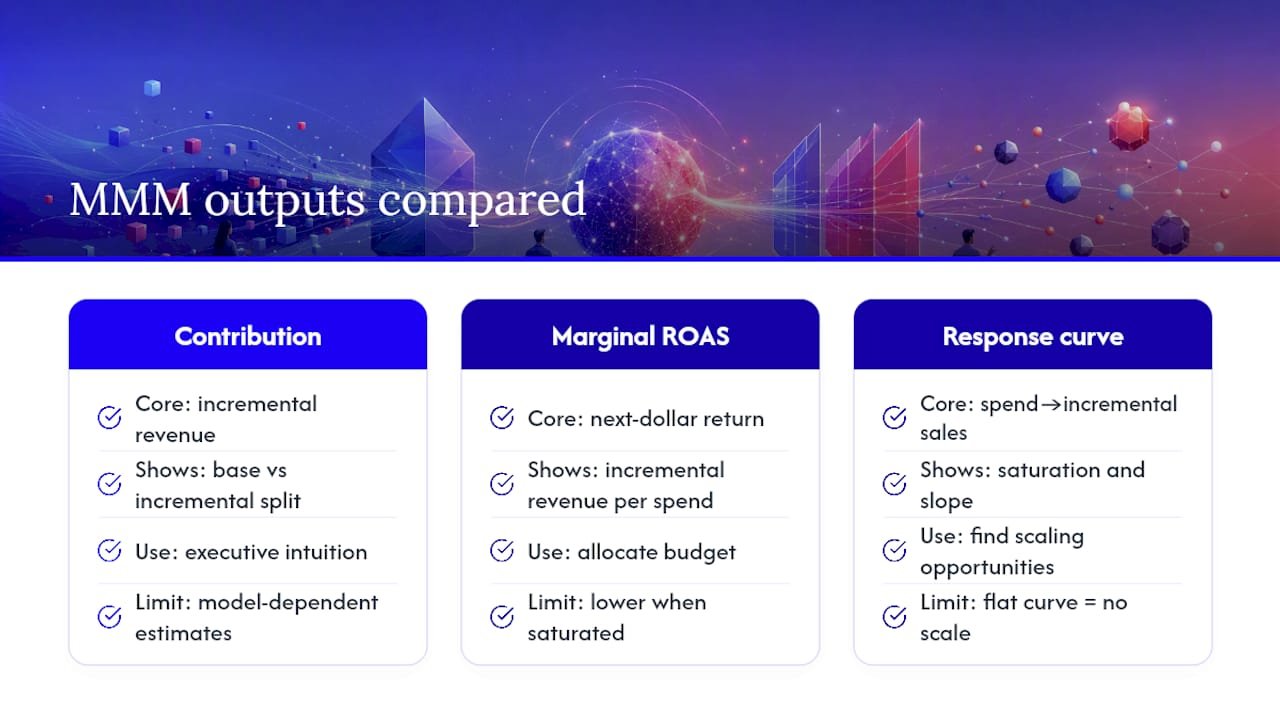
Every finished MMM produces the same three deliverables, and each one answers a different question.
Contribution decomposition breaks total sales into base and incremental components, then splits the incremental portion across every channel and driver in the model. This is the output executives want first because it’s intuitive: it says, in plain terms, how much of last quarter’s revenue marketing actually created versus what would have happened anyway. The limit to know here: contribution splits are model-dependent. Change your control variables or your adstock assumptions and the split shifts, sometimes by a meaningful margin. Treat contribution numbers as a well-reasoned estimate, not a ledger entry.
ROAS and marginal ROI answer a sharper question: what did the next dollar in each channel actually return? Average ROAS, revenue divided by spend, is the number most dashboards show, and it’s the wrong number for allocation decisions. It tells you what a channel has historically returned on average, not what it will return on the incremental dollar you’re about to spend. Adstock and saturation transforms exist precisely to let you calculate that marginal number, and it’s routinely lower than average ROAS for any channel already deep into its saturation curve.
Response curves are where the two prior outputs become visual and actionable. Plot spend on the x-axis and incremental sales on the y-axis for each channel, and you get a curve that shows exactly where each dollar sits relative to that channel’s saturation point.
That’s the entire value proposition of MMM in one sentence: it finds money the average-ROAS view hides.
Pro Tip: Before running any reallocation scenario, check where each channel currently sits on its response curve. A channel with great historical ROAS but a flat curve is not a scaling opportunity. It’s a channel to hold steady while you find room elsewhere.
Data Requirements, Common Pitfalls, and How to Fix Them
Model quality is a data quality problem before it’s a statistics problem. Enterprise-grade MMM typically runs on weekly data spanning two to three years or more, covering sales or revenue, spend by channel at the campaign or channel level, pricing, promotional calendars, distribution, and relevant exogenous factors like weather or macroeconomic indicators. Less history than that, and the model has too few seasonal cycles to separate real seasonality from noise. Monthly granularity instead of weekly tends to blur adstock effects that decay over two or three weeks, hiding them inside a single monthly bucket.
Four pitfalls account for most model failures in practice:
- Omitted variable bias. Leave out a real driver (a competitor’s price cut, a distribution expansion) and the model assigns its effect to whatever marketing variable moved at the same time.
- Correlated spend across channels. When TV and paid social budgets rise and fall together every quarter, the model struggles to tell which one actually drove the lift, a classic multicollinearity problem.
- Endogeneity. Spend decisions are often reactive. If a team boosts search spend specifically during high-demand weeks, the model can mistake demand-driven spend timing for spend-driven demand.
- Weak proxies for offline channels. Out-of-home and radio often get measured with GRPs or impression estimates that are themselves rough approximations, which limits how precisely the model can isolate their effect.
None of these are reasons to abandon MMM. They’re reasons to build with discipline. Add explicit control variables for anything you know moves sales independently of marketing. Where correlated spend is unavoidable, consider aggregating tightly correlated channels into a single variable rather than forcing the model to separate two signals it structurally cannot distinguish. Hierarchical or Bayesian structures with informative priors help stabilize estimates when the data itself is noisy or short. And for any offline channel with a shaky proxy, invest in better measurement (panel data, geo-level tracking) before trusting that channel’s coefficient at face value.
Pro Tip: If two channels move in near-lockstep in your spend history, don’t force the model to split credit between them. Combine them into one variable, get a clean joint estimate, and revisit the split only after you’ve deliberately varied their spend independently for a few months.
Building an MMM: A Step-by-Step Project Checklist
Most credible MMM programs follow the same general five-stage structure, whether the team builds in-house or works with an outside partner. Here’s what each stage actually involves.
- Define objectives and decision rules first. Decide what business question the model answers (budget reallocation, channel ROI, promotional impact) and what KPI it targets, before touching a spreadsheet. Set validation thresholds and guardrails now, not after you see results you like.
- Collect and audit every input. Pull sales or revenue, spend by channel, pricing, promotional calendars, distribution data, and relevant exogenous variables. Audit for gaps, definitional shifts (did “paid social” mean something different two years ago), and reporting lags before they contaminate the model.
- Prepare transforms and a conservative variable set. Apply adstock and saturation transforms, and resist the urge to throw every available variable into the model. A leaner, well-justified variable set beats an overloaded one that overfits historical noise.
- Build and validate rigorously. Fit the model, then test it against data it never saw. Out-of-sample holdout tests and backtests are non-negotiable here; a model that fits history beautifully but fails on a holdout period is not ready for a budget decision. Where possible, corroborate with an in-market test, a geo-holdout or lift study, rather than trusting model fit statistics alone.
- Activate and govern on an ongoing basis. Turn the finished model into scenario simulations the marketing team can run themselves, set reallocation guardrails so recommendations stay within the range the data actually supports, and build a refresh cadence so the model doesn’t quietly go stale as market conditions shift.
Pro Tip: Set your validation thresholds, minimum R-squared, acceptable MAPE range, holdout accuracy targets, before you see the first model output. Teams that set these rules after the fact tend to rationalize a mediocre model instead of rejecting it.
Advanced Practices: Bayesian Pipelines, Automation, and Safe Optimization
The gap between a serviceable MMM and a genuinely trustworthy one usually comes down to three practices: probabilistic estimation, automation, and disciplined guardrails on how far the model’s recommendations are allowed to extrapolate.
Bayesian inference’s real advantage isn’t philosophical purity. It’s that it produces credible intervals rather than single-point estimates for every parameter, including adstock decay and saturation thresholds. That matters operationally: a CFO deciding whether to shift $2 million between channels deserves to know whether the model’s confidence interval on that recommendation is tight or wide before committing.
Automation solves a different problem: speed. Modern MMM programs increasingly run on automated data pipelines with self-service scenario planning, which cuts the lag between a market shift and an updated recommendation from months to weeks. A model that refreshes quarterly is analyzing a market that no longer exists by the time results land on someone’s desk.
Guardrails are the least glamorous part of MMM and the most important for avoiding an expensive mistake. A model trained on spend levels ranging from $50,000 to $500,000 a week for a given channel has no real basis for recommending $2 million. That’s extrapolation far outside the training distribution, and models will happily generate that recommendation if nobody caps how far a scenario simulation is allowed to push.
- Cap the maximum reallocation percentage any single scenario run can recommend per channel per period.
- Run dual-optimizer checks, testing whether two different optimization approaches converge on similar recommendations, to surface model instability before it reaches a budget meeting.
- Monitor for model drift on a set cadence rather than waiting for an annual refresh to catch it.
- Cross-validate any large reallocation with an in-market test before committing the full budget shift.
Practitioner best practice is to treat MMM as decision support, not gospel: build in guardrails, and cross-validate against in-market tests before acting on any large reallocation recommendation.
That discipline is what separates teams that use MMM to make genuinely better decisions from teams that use it to produce a confident-looking chart nobody stress-tests before the money moves.
Teermoonline’s Practitioner View on MMM Programs
Applying marketing mix modeling well is less about the statistics and more about the discipline around them, and that’s where most in-house attempts stall out. Some agencies work with growth-focused businesses on the data integration and analytics work that MMM depends on: pulling together spend, sales, pricing, and promotional data from wherever it lives, then translating model outputs into scenario simulations a marketing team can actually act on.
The pattern that shows up again and again in engagements: teams have plenty of spend data and almost no discipline around control variables. They can tell you exactly what they spent on paid social last March. They usually can’t tell you what a competitor’s pricing did that same month, or whether a distribution change quietly inflated the baseline. Building a model without chasing down that context is how confident, wrong recommendations get made.
A practical approach to an MMM engagement starts with the same objective-setting discipline covered above: agree on the decision the model needs to support before building anything, then move through data collection, model build, and validation with holdout testing built in from the start, not bolted on afterward. The activation step matters just as much as the build. A model that produces a report nobody revisits is a wasted investment. A model wired into a scenario tool the marketing team runs monthly, with guardrails on how far any single reallocation can swing, is what actually changes a budget conversation.
Where MMM Falls Short: Data Delays, Market Shifts, and Model Drift
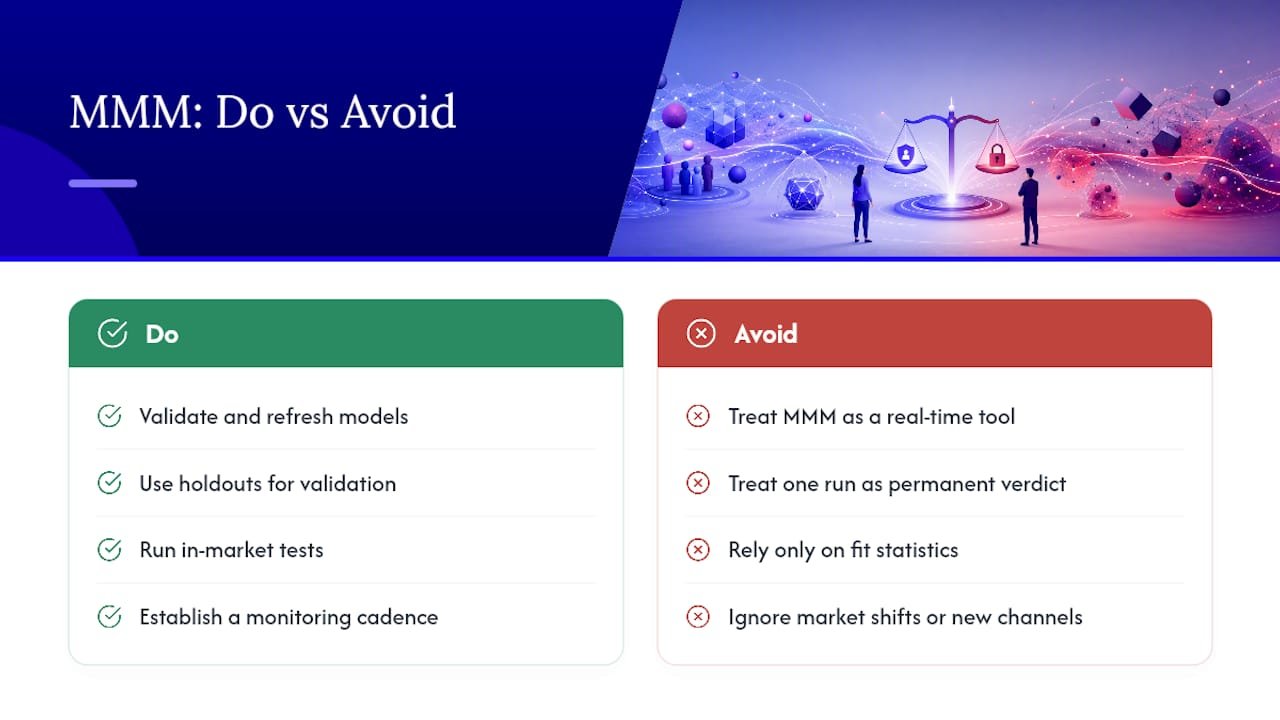
MMM is not a real-time tool, and treating it like one is a common source of disappointment. Data collection, cleaning, and model refresh cycles introduce a lag between a market shift and an updated recommendation. Even with automated pipelines, there’s a gap between “the market changed” and “the model reflects that change.”
Market conditions themselves are a moving target. A model calibrated on two years of relatively stable competitive dynamics can misfire the moment a major competitor changes pricing strategy or a new channel enters the mix with no historical data to anchor its coefficient. Models trained on the past are structurally bad at anticipating genuine discontinuities, a new regulation, a supply shock, a shift in consumer behavior that has no precedent in the training window.
Model drift compounds this quietly. A model’s coefficients were accurate when built, but media costs change, audience behavior shifts, and competitive intensity rises or falls. Without a monitoring cadence, a model can keep producing confident-looking outputs long after its underlying assumptions have stopped matching reality. There’s also a ceiling on precision itself: fit statistics like R-squared and MAPE describe how well a model explains historical data, not how correct its causal claims are. A model can fit history well and still misattribute credit between two correlated channels.
None of this argues against MMM. It argues for the validation and refresh discipline covered earlier, holdouts, in-market tests, and a monitoring cadence, rather than treating any single model run as a permanent verdict.
Fitting MMM Into a Broader Analytics Stack
MMM works best as one layer in a measurement stack, not a standalone oracle. Its natural partner is multi-touch attribution, which fills in the granular, channel-level detail that aggregate MMM cannot see, while MMM supplies the strategic, cross-channel context attribution structurally lacks. The two methods are frequently used to calibrate each other: when an attribution platform and an MMM disagree sharply on a channel’s contribution, that disagreement itself is diagnostic, usually pointing to a tracking gap or a missing control variable.
Incrementality testing and incrementality experiments (geo-holdouts, matched-market tests, PSA/ghost ad tests) serve as the empirical check on both methods. Where MMM estimates a channel’s contribution statistically, an incrementality experiment measures it directly by withholding spend in a controlled sample and observing the actual sales difference. Running a periodic incrementality test against your MMM’s own predictions is one of the more effective ways to catch a model that’s quietly drifted from reality.
Beyond attribution and incrementality testing, MMM should ideally connect to the same data infrastructure feeding a company’s broader marketing model optimization efforts: CRM systems for revenue data, ad platform APIs for granular spend, and business intelligence tools for the pricing and distribution data that make up the control variables. Treating MMM as an isolated annual project rather than an integrated part of ongoing marketing performance measurement is one of the most common reasons organizations under-invest in maintaining it.
Data Privacy and Ethical Guardrails in MMM Practice
MMM’s biggest ethical advantage is structural: it runs on aggregate data rather than individual user records, so it sidesteps most of the consent and tracking issues that plague user-level attribution. That’s a genuine privacy-first advantage, not a footnote. Building a model on weekly channel spend and sales totals means you’re not handling personally identifiable information at all in most implementations.
That doesn’t mean MMM programs are ethically or legally simple. Some of the exogenous and third-party data feeding these models (syndicated panel data, geo-level demographic data, credit bureau or transaction aggregates in some industries) can carry its own licensing, consent, and jurisdictional requirements depending on the source and the market. Any team sourcing external data for a model needs to confirm that data was collected and licensed appropriately for this use, rather than assuming aggregate data is automatically exempt from every privacy regime.
There’s also a quieter ethical dimension: transparency about model limitations. A model that presents a contribution estimate or a reallocation recommendation without disclosing its confidence range, or without acknowledging the control variables it couldn’t account for, risks steering real budget decisions on false certainty. Bayesian methods help here by making uncertainty a visible part of the output rather than something buried in a technical appendix. Treating that uncertainty honestly, and communicating it plainly to the executives who act on it, is as much a part of responsible MMM practice as the modeling itself.
The Practitioner’s Take on Where MMM Is Headed
Most MMM writing oversells the model and undersells the discipline around it. The math (regression, adstock, saturation) has been stable for decades. What’s actually changed is the tooling: Bayesian pipelines that surface uncertainty instead of hiding it, and automation that shrinks a quarterly exercise into something closer to continuous monitoring.
The overrated idea is that a bigger, more complex model automatically produces better decisions. It doesn’t. A lean, well-validated model with honest confidence intervals beats a sprawling one that overfits its own history every time a real reallocation decision is on the table.
If you’re prioritizing one thing this quarter, make it validation infrastructure, holdout tests and at least one in-market check, before you build a more elaborate model. Teams that skip straight to Bayesian sophistication without validation discipline end up with a beautifully uncertain model that’s still wrong.
— Teermo
Teermoonline: An External Partner for Your MMM Program
Some service providers are a practical option for teams that want an outside partner to run marketing mix modeling without building an internal data science function from scratch. Relevant services line up directly with what an MMM program needs: pulling together sales, spend, pricing, and promotional data from scattered sources, building and validating the model itself, and turning the output into scenario planning your team can run without re-opening a technical report every time.

A discovery call typically starts with the same objective-setting step covered in the project checklist above: what decision does the model need to support, what data already exists, and what gaps need filling before a build makes sense. From there, a pilot engagement can scope a model against a defined KPI and validate it with holdout testing before any larger reallocation gets recommended. If your team is weighing whether to build this capability in-house or bring in outside help to move faster, reach out through Teermoonline’s terms of use page to start that conversation and scope what a pilot would look like for your data.