


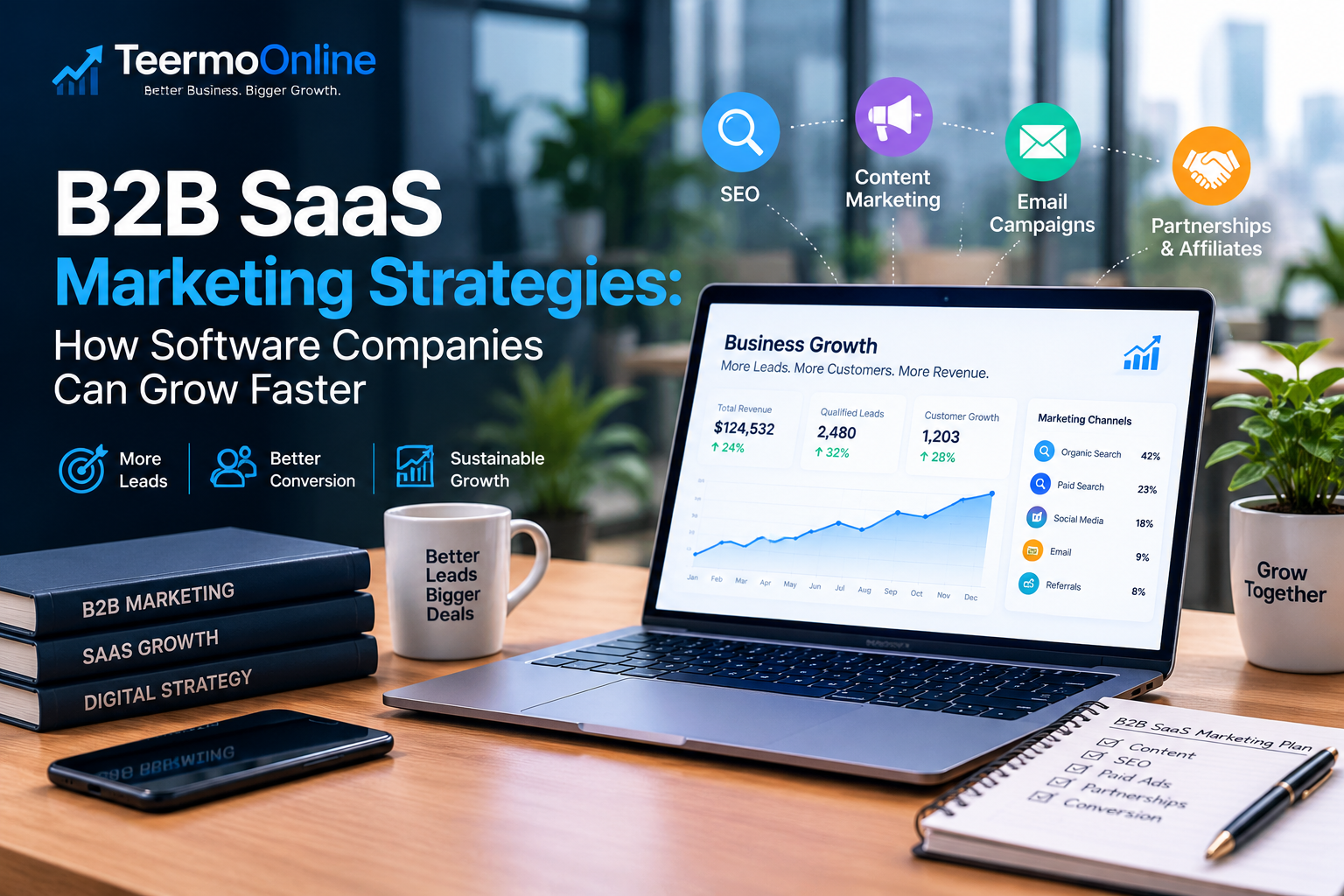
The Business-to-Business (B2B) Software-as-a-Service (SaaS) industry is one of the most competitive markets in the global digital economy. Unlike traditional software models where customers make a one-time purchase, SaaS relies entirely on continuous subscription revenue. For a SaaS company to survive and scale faster, it must not only acquire new corporate clients but also retain them over a lifetime. This unique dynamic means that traditional outbound marketing strategies often fall short. To achieve compounding and sustainable exponential growth, companies must leverage specialized B2B SaaS marketing frameworks that optimize the entire user journey from awareness to referral.
This comprehensive guide explores the most effective, data-driven B2B SaaS marketing strategies that modern software companies use to accelerate their conversion funnels, reduce customer acquisition costs, and maximize customer lifetime value.
1. Product-Led Growth (PLG) as a Core B2B SaaS Marketing Strategy
Product-Led Growth (PLG) is a business methodology where the software product itself serves as the primary driver of customer acquisition, retention, and expansion. Instead of relying solely on heavy sales pitches and long demo pipelines, PLG opens the product directly to the end-user through freemium tiers or free trials.
The Dynamics of Freemium vs. Free Trials
- The Freemium Model: Offers users access to a restricted version of the software indefinitely without charging a fee. This model is exceptionally powerful for building a massive top-of-funnel user base. It relies on usage thresholds, feature gates, or user seats to incentivize upgrades to premium plans.
- The Free Trial Model: Provides full or high-level access to the software but limits the usage time (typically 14 to 30 days). This model creates an immediate sense of urgency, forcing the user to evaluate the tool’s core value within a defined testing window.
Optimizing Time-to-Value (TTV)
The ultimate success of a product-led strategy depends on minimizing Time-to-Value (TTV). TTV represents the duration it takes for a new user to realize the product’s “Aha! Moment”—the exact instance they recognize the software’s capability to solve their operational pain points. To accelerate growth, SaaS marketers must collaborate closely with product management teams to streamline user onboarding. This includes eliminating friction by removing unnecessary sign-up forms, providing interactive product tours, and utilizing contextual in-app messaging to guide users toward valuable features quickly.
2. Advanced B2B Search Engine Optimization (SEO) & Semantic Content Marketing
For B2B SaaS organizations, search engine optimization is not merely about generating high traffic volumes; it is about capturing high-intent search queries from business decision-makers. A sustainable organic search strategy requires a shift from superficial keyword stuffing to deep semantic search optimization.
Implementing the Hub-and-Spoke (Topic Cluster) Model
Search engines favor comprehensive topical authority over isolated articles. SaaS companies can establish authority by structuring content into structured topic clusters:
- Pillar Page (The Hub): A long-form, comprehensive guide that broadly covers an entire core industry topic (e.g., “The Ultimate Guide to Enterprise Asset Management”).
- Spoke Content (Sub-topics): Multiple detailed sub-articles that hyper-focus on specific long-tail keywords relating to the pillar (e.g., “Asset Tracking Software for Healthcare” or “Best Asset Management KPI Frameworks”).
By interlinking these spoke articles back to the main pillar page, you signal to search engines that your website possesses deep, structured expertise across the entire subject matter.
       [ Pillar Page: Core SaaS Topic ]
                 ^    ^    ^
                /     |     \
               v      v      v
      [Spoke 1]   [Spoke 2]   [Spoke 3]
Targeting the Full Marketing Funnel
An effective content map balances articles across every stage of the user’s search journey:
- Top of the Funnel (TOFU): Informational content tackling broad business problems (e.g., “Why is Customer Churn High in Telecom?”).
- Middle of the Funnel (MOFU): Solution-oriented content comparing methodologies (e.g., “Automated Churn Analysis vs. Manual Spreadsheets”).
- Bottom of the Funnel (BOFU): High-converting transactional content targeting buyers who are ready to make a decision (e.g., “Best Enterprise Churn Analytics Software” or “Product X vs. Product Y Comparison”).
3. Account-Based Marketing (ABM) for High-Value Enterprise Contracts
When targeting large corporate accounts, generic broad-spectrum marketing campaigns rarely succeed. Enterprise software sales require Account-Based Marketing (ABM), a highly targeted strategy where marketing and sales departments join forces to treat an individual target corporation as its own specific, dedicated market.
The ABM Deployment Pipeline
- Identifying Ideal Customer Profiles (ICP): Marketers analyze historical client data to identify characteristics of their highest-yielding, lowest-churning enterprise clients. This includes analyzing parameters like company size, industry vertical, annual revenue, and geographic location.
- Data-Driven Target Account Lists: Using advanced intent intelligence tools, teams compile a highly specific list of companies currently exhibiting active interest or search behavior around their specific software niche.
- Hyper-Personalized Content Journeys: ABM teams build customized marketing collateral for individual accounts. This involves launching custom landing pages, tailored case studies, and individualized video demonstrations designed specifically to address the unique internal operational bottlenecks of the target corporation.
Through highly coordinated, multi-channel outreach—combining precision programmatic display advertising with personalized LinkedIn account targeting—ABM drastically reduces enterprise sales cycles and increases initial contract values.
4. Maximizing Growth Through Affiliate and Partner Marketing Networks
One of the most cost-effective and highly scalable distribution channels for modern B2B SaaS systems is partner and affiliate marketing. By leveraging third-party content creators, industry experts, agency partners, and existing clients, software companies can easily amplify their market reach without incurring upfront advertising costs.
Leveraging Strategic Affiliate Ecosystems
Unlike B2C affiliate setups that focus on volume and quick impulses, B2B SaaS affiliate programs focus heavily on expert trust, deep reviews, and programmatic alignment. B2B affiliate partners create thorough, data-supported content like step-by-step software tutorials, vertical-specific roundups, and implementation guides.
To run these operations seamlessly, companies utilize specialized platforms like PartnerStack. These systems automate the complex operational overhead of partner tracking, compliance monitoring, real-time attribution, and monthly recurring revenue (MRR) commission payouts.
Structuring High-Incentive Commission Models
To capture top-tier B2B affiliates and publishers, companies must design compelling incentive structures:
- Recurring Commission Structure: Instead of single one-off payouts, programs offer a continuous percentage (e.g., 20% to 30%) of the customer’s subscription fee for the entire first year or lifetime of the contract. This aligns the incentives of both the software vendor and the publisher perfectly.
- Tiered Performance Bonuses: Providing milestone-based payouts or increased commission baselines when an affiliate crosses specific monthly referral thresholds encourages long-term dedication and higher quality traffic.
5. Paid Performance Marketing and Dynamic Retargeting
Paid acquisition provides the necessary immediate traffic boost to complement long-term organic strategies. In B2B SaaS, the goal of paid campaigns is to capture high-intent users on search platforms and steadily nurture them across social networks.
Search Engine Marketing (SEM) Precision
Google Ads remains a core component for capturing high-intent bottom-of-funnel traffic. SaaS companies must aggressively bid on high-conversion keywords, including competitor alternative terms (e.g., “Alternative to Competitor X”). Because these keywords can have a high Cost-Per-Click (CPC), ad copy must focus precisely on clear, unique value propositions, leading directly to dedicated, hyper-optimized landing pages with zero distractions.
Multi-Channel Retargeting Frameworks
Because B2B buyers rarely convert on their first interaction, a robust multi-tier remarketing setup is non-negotiable:
| Layer | Audience Segment | Ad Content Type | Primary Goal |
|---|---|---|---|
| Layer 1 | Anonymous Website Visitors | Educational blog posts, video thought leadership | Brand Awareness & Trust Building |
| Layer 2 | Pricing Page Visitors | Real customer case studies, ROI calculators | Lead Capture (Demo Sign-up) |
| Layer 3 | Expired Free-Trial Users | Limited-time introductory discounts, new feature rollouts | Reactivation & Conversion |
By using platforms like LinkedIn Campaign Manager and Meta Content Networks, companies can remain top-of-mind throughout the customer’s decision-making process.
6. Key B2B SaaS Metrics and Growth Optimization Analytics
An aggressive marketing campaign is meaningless without proper analytical tracking. B2B SaaS relies heavily on recurring revenue models, which means marketing performance must be measured using long-term financial health indicators rather than simple upfront traffic metrics.
+---------------------------------------+

|  Customer Lifetime Value (LTV)        |
|  ------------------------------ > 3X  |
|  Customer Acquisition Cost (CAC)      |
+---------------------------------------+
The Critical SaaS Growth Equations
- Customer Acquisition Cost (CAC):
$$\text{CAC} = \frac{\text{Total Sales + Marketing Expenses}}{\text{Number of New Customers Acquired}}$$
This calculates the exact amount of capital required to win a single new user. - Customer Lifetime Value (LTV):
$$\text{LTV} = \frac{\text{Average Revenue Per Account (ARPU)} \times \text{Gross Margin}}{\text{Customer Churn Rate}}$$
This quantifies the total gross revenue a business can expect to generate from a single customer over their entire subscription lifecycle. - The LTV:CAC Ratio:
The definitive health metric of SaaS scalability. A healthy, fast-growing SaaS business should maintain an LTV:CAC ratio of 3:1 or higher. If the ratio falls below 3:1, the marketing spend is inefficient; if it exceeds 5:1, the company is likely underspending and missing valuable growth opportunities. - Churn Rate Calculation:
$$\text{Customer Churn Rate} = \frac{\text{Customers Lost During Period}}{\text{Total Customers at Start of Period}} \times 100$$
High churn acts as a leaky bucket, completely wiping out the value of incoming marketing traffic. Marketers must optimize retention by tracking user engagement data and creating automated email campaigns to re-engage users showing low activity levels.
Conclusion: Building a Compounding Growth Engine
Accelerating growth within the B2B SaaS landscape requires a balanced, multi-channel approach. By combining the immediate accessibility of Product-Led Growth (PLG), the long-term compounding returns of Topic Cluster SEO, the laser focus of Account-Based Marketing (ABM), and the scalable leverage of Affiliate Networks like PartnerStack, software organizations can build a resilient, high-converting growth engine.
As you deploy these core strategies, focus on maintaining your critical LTV:CAC ratios, keeping user onboarding friction low, and continuously updating your content architecture. The shirkado that successfully connect high-intent digital marketing with frictionless product value are the ones that will scale fastest and dominate the modern enterprise software landscape.
For long-term scaling, check out our comprehensive guide on B2B customer acquisition strategies.