

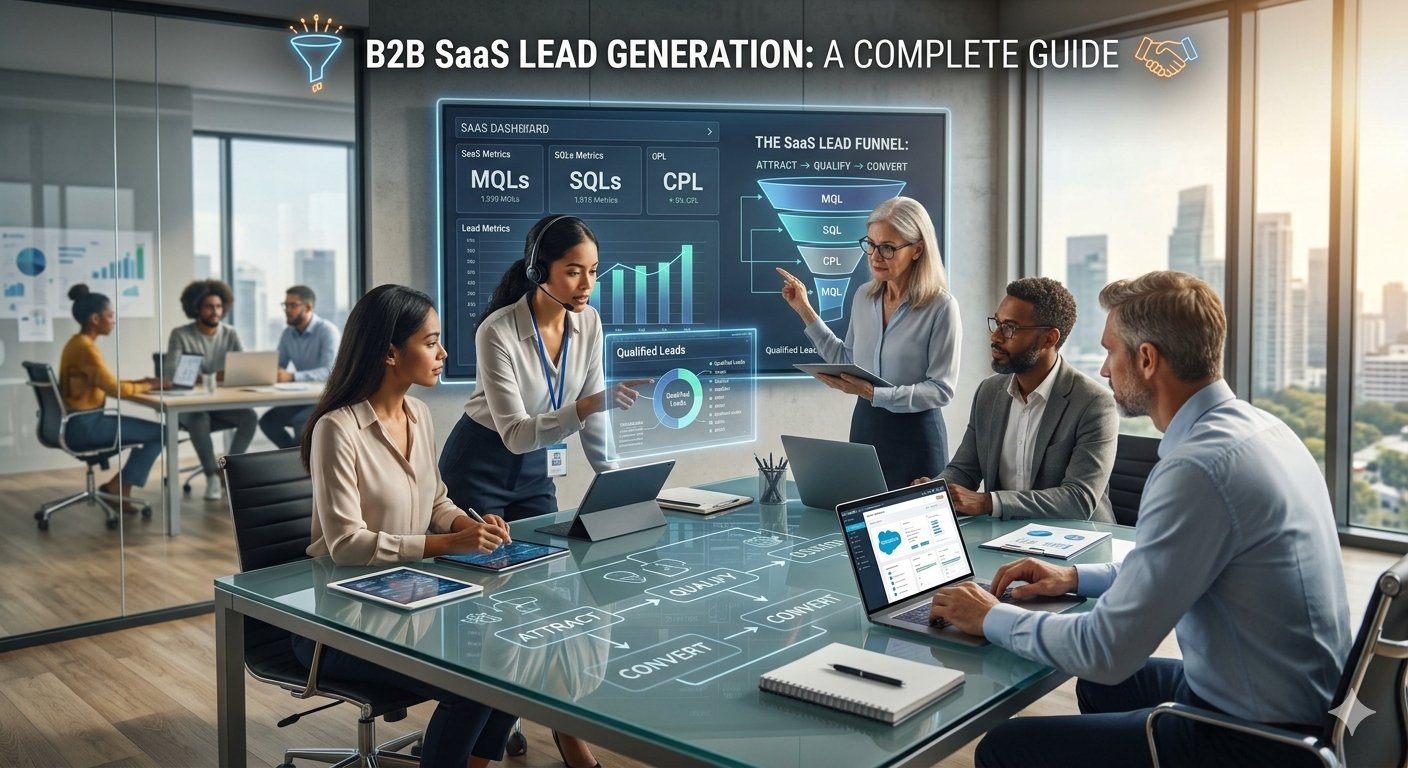
B2B SaaS lead generation is the process of acquiring high-quality leads within in the Business-to-Business (B2B) Software-as-a-Service (SaaS) sector is fundamentally different from traditional online marketing. In the consumer space (B2C), a buyer might see a social media ad, click a link, and purchase a software subscription within five minutes. The emotional friction is low, the price point is typically minimal, and the decision-making process involves a single individual. In contrast, the B2B SaaS landscape operates on a completely different framework. Here, buyers are corporate entities, department heads, financial officers, and procurement teams. The sales cycle often spans several months, involves multiple stakeholders, and requires deep organizational trust.
Because of this complexity, software companies cannot rely on simple vanity metrics like total website traffic or raw numbers of free trial sign-ups. True growth requires a structured, repeatable pipeline designed specifically to find, attract, and nurture qualified leads. These are prospects who have a genuine operational need for the platform, the technical infrastructure to integrate it, and the financial budget to pay for it long-term.
1. Defining Qualified Leads in the SaaS Universe
Before spending a single dollar on advertising campaigns or content production, marketing and sales teams must agree on a unified definition of what constitutes a valuable lead. Treating every email sign-up equally is a fast track to wasting corporate resources on users who will never convert into paying customers. This requires a deep understanding of the lead lifecycle stages and a mathematically backed definition of target metrics.
Marketing Qualified Leads (MQLs) vs. Sales Qualified Leads (SQLs)
The transition from a casual website visitor to a paying enterprise subscriber involves distinct phases. Understanding where a prospect sits in this journey determines how your team should interact with them.
Marketing Qualified Leads (MQLs) are individuals who have interacted with your brand’s marketing materials but are not quite ready to purchase. These buyers are at the top or middle of the conversion funnel. For example, a user might download an enterprise whitepaper regarding industry benchmarks, register for a live webinar, or spend a significant amount of time reading high-intent blog posts. They show interest, and their corporate profile matches your basic targets, but their immediate buying intent is still unverified. They require further educational nurturing before being handed over to a sales representative.
Sales Qualified Leads (SQLs) are prospects who have actively moved down the conversion funnel and have been vetted by the sales development team. An SQL typically displays direct, immediate buying indicators. This includes actions such as requesting a customized price quote, booking a live product demonstration, or filling out a detailed questionnaire regarding their company’s specific technical challenges. When a lead reaches SQL status, it signals that they have a validated pain point, an active timeline, and the authority to make a purchasing decision.
Establishing Your Ideal Customer Profile (ICP)
An Ideal Customer Profile (ICP) is a data-backed blueprint of the exact type of company that derives maximum value from your software and generates the highest customer lifetime value for your business. Designing a precise ICP prevents your marketing campaigns from targeting the wrong audience, thereby protecting your customer acquisition costs. To build a resilient ICP, you must analyze your current top tier of paying clients and categorize them based on a combination of specific architectural pillars.
Firmographics form the baseline of your profile. This includes identifying specific industry verticals, narrow employee size ranges, and geographic locations that match your service capabilities. For instance, an enterprise human resources software might target companies with five hundred to two thousand employees located in North America.
Financial parameters evaluate whether the target organization can afford your subscription rates. This involves looking at annual revenue baselines, general growth trajectories, and available software budgets. Targeting companies that are financially strained leads to high churn rates and lower contract values.
Technographics evaluate the prospect’s existing legacy infrastructure and software stack. Your software must either integrate smoothly with their current tools or replace a specific component of their pipeline without causing severe operational disruption. If your tool requires a native integration with Salesforce, companies using legacy databases are automatically excluded from your ICP.
Behavioral data reflects the active operational bottlenecks and corporate growth goals of the organization. This looks at whether the company is currently expanding its teams, restructuring its digital infrastructure, or facing specific regulatory compliance updates that your software can help resolve.
2. Inbound Lead Generation: Turning Your Website into a Sales Engine
Inbound marketing is the structural practice of creating highly valuable content and user experiences that draw prospects toward your software naturally. Instead of interrupting busy executives with unsolicited outreach, you position your brand as the definitive authority to solve their existing corporate challenges.
High-Value Lead Magnets & Gated Content Strategy
Business buyers will not hand over their corporate email address or phone number for a basic, brief blog post that contains generic information easily found via a quick search. To capture high-intent leads, you must offer premium, authoritative content assets, often referred to as lead magnets. The most effective gated content assets for B2B software buyers must provide immediate utility.
In-depth industry reports featuring proprietary data research are highly prized by corporate executives. These assets provide unique market trend analysis, statistical benchmarks, and predictive insights that decision-makers can use to justify their operational strategies to corporate boards or external investors.
Interactive return on investment (ROI) calculators serve as powerful mid-funnel lead magnets. These web-based tools allow prospective buyers to input their internal company metrics, such as monthly labor hours or current operational costs, and instantly see the exact financial savings or productivity gains your software provides. This makes the business case for your software clear and quantifiable.
Ready-to-use operational frameworks provide immediate workplace relief. These include customizable spreadsheets, technical implementation checklists, or legal compliance document templates that solve an immediate bottleneck. When a prospect downloads a tool that simplifies their workday, their trust in your brand increases significantly.
Landing Page Optimization & Form Design Friction
A common mistake in SaaS lead generation is creating overly complicated forms that demand too much information upfront. Every additional field you add to a landing page signup form reduces the conversion rate. However, forms that are too brief can result in a massive volume of low-quality leads that overwhelm your sales development reps. Finding the right balance requires a strategic approach to form friction.
Low friction strategies use name and email fields only. This approach provides a maximum volume of sign-ups, making it ideal for building large top-of-funnel email lists for newsletters or introductory webinars. The disadvantage is that it yields a high percentage of unqualified leads, requiring extensive manual cleanup.
High friction forms demand detailed corporate intelligence, including job titles, company size, annual revenue, and current software stacks. This approach delivers highly vetted leads and provides sales reps with crucial context before a call. The downside is that it drastically reduces overall conversion volumes, as busy executives may abandon the process.
To achieve the best of both worlds, modern SaaS platforms utilize progressive profiling. This technology utilizes smart cookies to recognize returning website visitors. Instead of showing the same form, the system dynamically changes the fields over time, collecting new pieces of customer intelligence across multiple visits without overwhelming the user during their first interaction.
3. Outbound Lead Generation: Precision Target Outreach
While inbound marketing acts as a magnet, outbound lead generation acts as a spear. For high-ticket enterprise software solutions, waiting for major corporations to find your blog naturally is not fast enough. You must actively and precisely approach key decision-makers within your target ICP accounts.
Data-Driven Prospecting Tools
Outbound success begins with clean, verified, and legally compliant data. Sales development representatives (SDRs) utilize advanced prospecting platforms like LinkedIn Sales Navigator, ZoomInfo, and Cognism to build hyper-specific lists of corporate executives who hold decision-making power. These roles typically include Chief Technology Officers, VPs of Marketing, or Directors of Procurement.
These advanced platforms allow you to filter prospects not just by job title, but also by recent company hiring trends, funding rounds, and technology stack updates. For example, if a target enterprise company recently hired a new Director of Security, that executive is likely auditing their internal tools, creating a perfect window of opportunity for an outbound software pitch.
Cold Email Personalization Scale
Generic, template-based cold emails that read like mass blasts are instantly deleted, ignored, or flagged as spam, which can destroy your domain email deliverability. Modern outbound outreach must be highly personalized to cut through the noise of a busy corporate inbox. A high-converting outbound email structure follows a specific, logical framework.
It starts with genuine context regarding a recent company milestone, such as a public press release, a recent product launch, or a shared professional insight on social media. This proves that you have researched their business specifically.
Next, it moves into identifying a specific operational friction point common to their industry sector. Instead of pitching features, you focus entirely on the negative business impact of that bottleneck, such as lost revenue or security vulnerabilities.
The email then provides short social proof detailing how you helped a similar brand solve that exact problem. Using specific figures, such as a percentage increase in efficiency or a concrete reduction in costs, adds massive credibility to your claim.
Finally, it ends with a low-friction call to action. Instead of pushing for an immediate thirty-minute formal meeting, ask a simple, open-ended question to start a conversation, such as whether they are currently experiencing similar bottlenecks in their pipeline.
4. Leveraging Affiliate Networks for Scalable B2B SaaS Leads
One of the most efficient ways to build a highly scalable lead generation pipeline is by delegating market outreach to trusted industry partners, content creators, and independent software review networks. This is where partner platforms play a vital role.
The Role of B2B Software Publishers
In the business world, buyers look for third-party validation before investing in corporate software. They consult independent software comparison platforms, read niche industry blogs, and look for advice from specialized consulting groups. By establishing an automated partner program via networks like PartnerStack, a SaaS brand can place its platform directly into these high-trust conversion paths.
Affiliate partners promote your software by writing objective comparison reviews, creating detailed step-by-step video tutorials, and sharing real-world case studies with their established audiences. Because these publishers already have the trust of your target audience, their referrals convert at a much higher rate than cold paid traffic.
Cost-Per-Lead (CPL) vs. Cost-Per-Acquisition (CPA) Pay Structures
When setting up a B2B partner framework, software companies can incentivize partners using different payout structures to drive specific funnel behaviors.
Under a Cost-Per-Lead (CPL) setup, the affiliate receives a small, fixed payout for every verified corporate sign-up or booked demo they refer. This structure is excellent for rapidly expanding your marketing database and filling your funnel with fresh sales prospects. However, it requires strict monitoring to ensure the incoming leads match your ICP criteria.
Alternatively, a Cost-Per-Acquisition (CPA) structure rewards the affiliate with a percentage of the contract value or a flat bonus only when the lead converts into a paying subscriber. CPA models are highly secure because the marketing cost is directly tied to realized revenue. Many top-performing B2B SaaS brands use a hybrid model, paying a small reward for a qualified SQL and offering a larger bonus once that account completes its first official subscription payment.
5. Intent Data Intelligence: Capturing Buyers in the Window of Need
One of the most revolutionary developments in modern B2B lead generation is the ability to track and analyze B2B intent data. Intent data allows software brands to identify exactly which corporations are actively shopping for a solution before they ever fill out a form on your website.
Third-Party Intent Monitoring
Platforms like Bombora and G2 track web-browsing activities across thousands of B2B publishing networks, research sites, and tech review directories. If a company with hundreds of employees suddenly starts reading articles about enterprise software migration, researching pricing structures, or spending hours comparing alternative software products on a review site, the intent platform flags this behavior as a surge in buying interest.
This indicates that the organization is actively in the market for a solution, creating a temporary window of need where they are highly receptive to sales messages.
Immediate Automated Outreach Actions
Once an intent surge is identified, your marketing and sales teams can immediately execute automated, highly coordinated plays to capture the account.
They can launch programmatic digital ad campaigns focused specifically on employees working within that surging company, highlighting your software’s ease of migration and superior support infrastructure.
Simultaneously, this signals your sales development reps to initiate personalized outbound email sequences to the key decision-makers at that specific account, offering a tailored demonstration that addresses the exact topic they are researching.
Finally, if an employee from that surging organization clicks an ad and arrives at your website, you can display a customized landing page experience tailored to their exact industry challenges, making your solution feel uniquely qualified to help them.
6. Lead Nurturing and Scoring Frameworks
Capturing a lead is only half the battle. Because B2B buyers require time to align internal teams, analyze budgets, and review legal contracts, a large percentage of your incoming leads will not buy immediately. Lead nurturing is the structured process of sending targeted, automated educational content to your prospects over time, keeping your product top-of-mind until they are ready to purchase.
Designing a Point-Based Lead Scoring System
To prevent sales reps from wasting time calling cold or unengaged leads, organizations use point-based lead scoring models within their marketing automation platforms to track user activity. Leads accumulate or lose points based on their behavior and firmographic data.
Demographic fits look at whether the lead matches your target profile. An enterprise executive matching your ICP exactly might receive an immediate addition of thirty points, while a student or hobbyist might receive negative points.
Behavioral triggers track engagement levels. A user visiting your subscription pricing page might receive an addition of fifteen points, while downloading an implementation whitepaper adds ten points.
Inactivity penalties are applied if a user loses interest over time. If a prospect does not open an email or visit your website for several consecutive weeks, the system automatically subtracts points from their score.
Once a lead’s cumulative score crosses a predetermined threshold, their account is automatically upgraded to sales-ready status within your CRM, triggering an immediate notification for a sales rep to reach out personally while the lead is hot.
Conclusion: Engineering a Sustainable Pipeline
Building a resilient B2B SaaS lead generation engine requires combining different marketing channels into a cohesive system. Relying entirely on a single strategy leaves your company vulnerable to changing market dynamics, shifting ad costs, or search algorithm updates.
By balancing the organic growth of inbound content, the pinpoint focus of outbound account outreach, the scalable leverage of affiliate networks like PartnerStack, and the predictive power of intent data intelligence, software companies can construct a dependable growth pipeline. Implement clear lead scoring frameworks, keep your landing page signup forms streamlined, and continuously evaluate your marketing metrics against clear revenue outcomes. The software brands that successfully guide high-quality leads through a structured, value-driven conversion journey are the ones that will scale fastest and lead their competitive markets.