


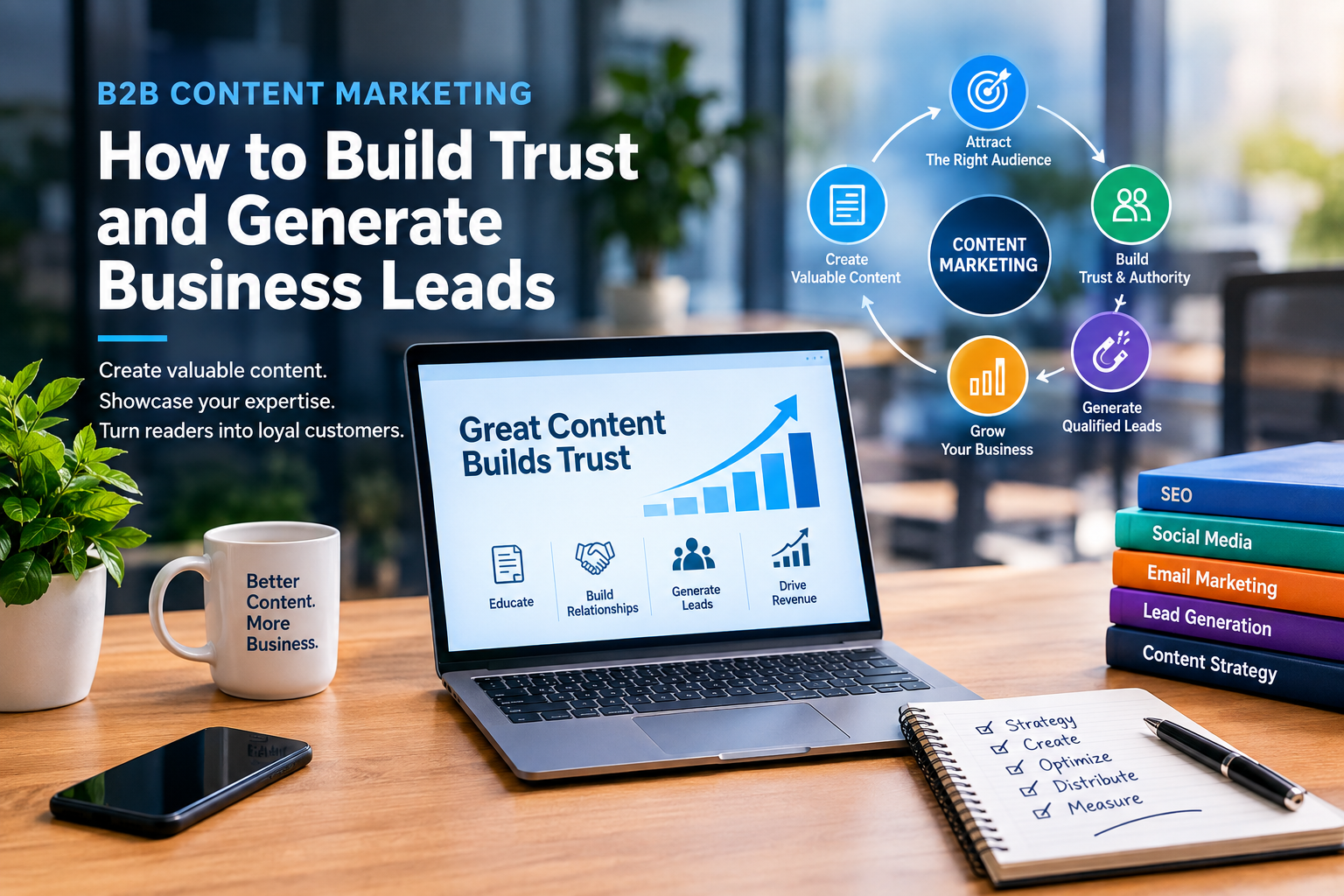
B2B buying has changed dramatically.
Business buyers no longer depend entirely on sales representatives to explain what a product does or why they should consider buying it. Before contacting a company, many decision-makers now research problems online, compare different solutions, read industry articles, watch demonstrations, study customer reviews, and look for evidence that a company understands their particular challenges.
This shift has made content marketing one of the most valuable tools available to B2B companies.
But effective B2B content marketing is not simply about publishing blog posts every week. Producing a large volume of articles does not automatically create trust, generate qualified leads, or increase revenue.
The real objective is to create useful information that helps potential customers make better decisions while gradually establishing the company as a credible source of expertise.
When done correctly, content can attract people who are actively searching for solutions, educate them during the buying process, demonstrate expertise, and eventually turn interested visitors into business leads.
This guide explains how modern B2B companies can build a content marketing strategy that combines useful information, search visibility, credibility, technology, and measurable lead generation.
What Is B2B Content Marketing?
B2B content marketing is the process of creating and distributing valuable information for businesses and professional decision-makers.
Unlike traditional advertising, which often focuses directly on promoting a product, content marketing starts with the customer’s problem.
A company might publish content about:
- Industry trends
- Common business challenges
- How-to guides
- Market research
- Product comparisons
- Case studies
- White papers
- Research reports
- Webinars
- Expert interviews
- Software guides
- Business strategies
The purpose is to answer questions and provide useful information before asking the reader to become a customer.
For example, a cybersecurity company could publish an article explaining how small businesses can identify common security vulnerabilities.
The article does not need to immediately sell a cybersecurity package.
Instead, it demonstrates that the company understands cybersecurity problems. A reader who finds the article useful may later explore the company’s services, subscribe to its newsletter, download a security checklist, or request a consultation.
That is how content can support the buying journey.
Why Trust Matters So Much in B2B Marketing
Trust is particularly important in B2B markets because business purchases can involve significant financial and operational consequences.
A company choosing accounting software, cybersecurity services, cloud infrastructure, CRM software, or marketing technology is not simply making a casual purchase.
The decision may affect employees, customers, budgets, compliance, productivity, and long-term operations.
Buyers therefore want evidence.
They want to know:
Does this company understand my problem?
Can I trust its information?
Does the product actually work?
Have other businesses achieved results with it?
What happens after I become a customer?
Good content can begin answering these questions long before a salesperson becomes involved.
Start With the Customer, Not the Keyword
One of the biggest mistakes in content marketing is creating content around keywords without understanding the people searching for them.
Search volume can be useful, but it does not tell the entire story.
A B2B marketer should first understand the target audience.
This includes:
- Industry
- Company size
- Job role
- Responsibilities
- Business objectives
- Common problems
- Budget limitations
- Buying authority
- Technical knowledge
- Concerns about implementation
A marketing manager and a chief financial officer may search for information about the same software but have very different priorities.
The marketing manager may care about integrations and campaign performance.
The CFO may care about cost, return on investment, security, contracts, and financial predictability.
Content becomes more effective when it reflects these different perspectives.
Build Detailed B2B Buyer Personas
Buyer personas help content teams understand who they are writing for.
A useful B2B persona should go beyond basic demographic information.
Instead, document:
Role: Who is involved in the decision?
Business problem: What problem are they trying to solve?
Desired outcome: What would success look like?
Barriers: What might prevent them from buying?
Research behavior: Where do they look for information?
Decision criteria: What factors influence the final choice?
Internal stakeholders: Who else needs to approve the purchase?
These details make content more specific.
A generic article titled “Benefits of CRM Software” may attract broad traffic.
A more focused article such as “How Growing B2B Sales Teams Can Choose a CRM Without Creating More Administrative Work” speaks to a specific audience and problem.
Specificity often creates stronger engagement.
Create Content for Every Stage of the Buying Journey
Not every visitor is ready to buy.
Some people are discovering a problem for the first time. Others are actively comparing solutions. Some are already evaluating vendors.
A strong B2B content strategy addresses all of these stages.
Awareness Content
At the awareness stage, people are usually researching a problem rather than a specific company.
Examples include:
- “Why Sales Teams Lose Qualified Leads”
- “How Businesses Can Reduce Customer Churn”
- “Common Cybersecurity Risks for Small Companies”
- “How to Improve B2B Lead Generation”
The goal is education.
Consideration Content
At this stage, potential buyers understand the problem and are researching possible solutions.
Useful content includes:
- Software comparisons
- Detailed guides
- Solution-specific articles
- Webinars
- Case studies
- Industry reports
- Implementation guides
The reader is beginning to evaluate options.
Decision Content
Decision-stage visitors need confidence.
They may be looking for:
- Pricing information
- Product demonstrations
- Customer testimonials
- ROI information
- Case studies
- Implementation details
- Security documentation
- Comparison pages
This content can help remove the final barriers to purchase.
Create Topic Clusters Instead of Isolated Articles
Publishing unrelated articles can make a website difficult to understand.
A better approach is to build topic clusters.
For example, a company targeting B2B lead generation might create a central guide about B2B lead generation and connect it to supporting articles about:
- Lead qualification
- LinkedIn lead generation
- SEO for B2B companies
- Landing page optimization
- Lead scoring
- Marketing automation
- Email nurturing
- Conversion rate optimization
The central page provides broad coverage while supporting articles explore specific questions.
This structure can improve navigation, create stronger topical relevance, and give readers multiple ways to continue learning.
Focus on Original Insights
One of the biggest challenges in modern content marketing is differentiation.
The internet already contains enormous amounts of generic business content.
Simply rewriting information that already exists is unlikely to establish strong authority.
B2B companies should look for ways to add original value.
That could include:
- Proprietary research
- Customer data
- Expert interviews
- Original surveys
- Industry observations
- Internal benchmarks
- Case studies
- Practical frameworks
- First-hand experiences
Even small amounts of original information can make an article significantly more useful.
For example, instead of publishing another general article about email marketing, a company could analyze its own campaign performance and explain which approaches generated the strongest engagement.
That type of information cannot simply be copied from another website.
Use Case Studies to Demonstrate Real Results
Case studies are among the strongest forms of B2B content because they connect a solution with an actual business outcome.
A good case study explains:
- The customer’s original problem
- Why the problem mattered
- The solution that was implemented
- How the implementation worked
- The challenges encountered
- The measurable results
- What the company learned
Numbers make case studies particularly powerful when they can be disclosed accurately.
For example:
“After restructuring its lead qualification process, the company reduced response time by 38% and increased qualified opportunities by 22%.”
Specific evidence is more convincing than vague statements such as “The solution dramatically improved performance.”
Make B2B Content Easy to Read
B2B content does not need to sound complicated to be professional.
In fact, unnecessary jargon can make content harder to trust.
Strong business writing should be:
- Clear
- Specific
- Useful
- Well structured
- Evidence-based
- Easy to scan
Use short paragraphs, meaningful headings, lists, examples, charts, and tables where appropriate.
Readers often scan business articles before deciding whether to read them completely.
The structure should therefore make important information easy to find.
Combine SEO With Real Reader Value
Search engine optimization remains important for B2B content, but SEO should support the content rather than control it.
Start by understanding search intent.
Someone searching for “what is CRM” has a different intent from someone searching for “best CRM for 50 person sales team.”
The first query is educational.
The second suggests stronger commercial intent.
Content should match the reason behind the search.
Important SEO elements include:
- Clear page titles
- Descriptive headings
- Natural keyword usage
- Internal linking
- Useful metadata
- Fast page performance
- Mobile usability
- Structured content
- Relevant external references
- Helpful original information
However, inserting keywords repeatedly can make an article unnatural.
Modern search visibility increasingly depends on whether content actually satisfies the user’s information need.
Build a Strong Internal Linking Strategy
Internal links are often overlooked.
A useful article should lead readers toward other relevant resources.
For example, an article about B2B content marketing might link to related guides covering:
- SEO
- Lead generation
- Email marketing
- Conversion optimization
- Marketing analytics
- Social media strategy
This creates a connected content ecosystem.
It also helps visitors move from general educational content toward more detailed resources and, eventually, commercial pages.
Use Content Upgrades to Generate Leads
Traffic is useful, but traffic alone does not pay the bills.
B2B marketers need mechanisms for turning interested readers into identifiable prospects.
One effective approach is the content upgrade.
A company might offer a useful resource related to an article, such as:
- A checklist
- Template
- Spreadsheet
- Research report
- Planning worksheet
- Guide
- Industry benchmark
- Audit framework
For example, an article about B2B content strategy could offer a downloadable “30-Day B2B Content Planning Template.”
The visitor receives something useful, while the company gains an opportunity to continue the relationship.
Use Calls to Action Without Overdoing Them
A call to action, or CTA, tells the reader what to do next.
Examples include:
- Download the guide
- Request a demo
- Start a free trial
- Subscribe to updates
- Talk to an expert
- View the case study
- Explore the product
The CTA should match the reader’s stage.
Someone reading an introductory educational article may not be ready for a sales call.
A newsletter subscription or detailed guide may be more appropriate.
On the other hand, someone reading a pricing comparison or implementation guide may be much closer to making a purchase.
Nurture Leads After They Convert
Lead generation does not end when someone submits a form.
Many B2B purchases take time.
A potential customer might need weeks or months to compare vendors, obtain internal approval, secure budget, and complete procurement.
Lead nurturing keeps the relationship active during this period.
Useful follow-up content can include:
- Educational emails
- Customer stories
- Product guides
- Industry research
- Webinars
- Implementation resources
- Frequently asked questions
The objective is to remain useful without becoming intrusive.
Use LinkedIn as a Content Distribution Channel
B2B companies should not rely entirely on Google for content distribution.
Professional networks can be highly effective for reaching decision-makers.
LinkedIn, in particular, can be used to distribute:
- Article summaries
- Original research
- Executive insights
- Industry commentary
- Short videos
- Customer stories
- Data visualizations
- Practical tips
The best approach is usually not to copy an entire blog article into a social post.
Instead, extract one useful insight, explain why it matters, and invite readers to explore the deeper resource.
Repurpose Strong Content
Creating high-quality B2B content requires time.
Repurposing allows companies to get more value from each strong piece.
A detailed article can become:
- A LinkedIn post
- A short video
- A presentation
- An infographic
- An email newsletter
- A webinar
- Several short social posts
- A sales enablement document
For example, a 2,500-word research article might generate an entire month’s worth of smaller content pieces.
This makes the content strategy more efficient without requiring the marketing team to constantly start from zero.
The Growing Role of AI in B2B Content Marketing
Artificial intelligence is changing how content teams research, organize, and produce information.
AI tools can help marketers:
- Generate topic ideas
- Analyze search intent
- Organize research
- Summarize large datasets
- Create content outlines
- Identify content gaps
- Personalize communications
- Analyze performance
- Repurpose existing material
However, there is an important distinction between using AI as a productivity tool and publishing large quantities of generic machine-generated content.
The second approach can create a website filled with repetitive information that provides little unique value.
A stronger model is human-led content supported by AI.
AI can accelerate research and production, while human experts provide:
- Experience
- Judgment
- Original insights
- Interviews
- Data interpretation
- Brand perspective
- Editorial quality
The result should feel useful and credible rather than mechanically produced.
Establish Editorial Standards
As a B2B content operation grows, consistency becomes important.
Create basic editorial standards covering:
- Writing style
- Tone
- Sources
- Fact checking
- Statistics
- Formatting
- Images
- Links
- Author information
- Review process
If content discusses technical, financial, legal, or security-related subjects, expert review can be particularly valuable.
Strong editorial processes protect credibility.
Measure the Metrics That Actually Matter
Page views are useful, but they are not enough.
B2B marketers should connect content performance with business outcomes.
Important metrics include:
Organic Traffic
Measures how many visitors arrive through search engines.
Engagement
Metrics such as time on page, scroll behavior, and returning visitors can indicate whether content is useful.
Conversion Rate
Measures the percentage of visitors who complete a desired action.
Marketing Qualified Leads
MQLs help identify leads that meet defined marketing criteria.
Sales Qualified Leads
SQLs are prospects considered sufficiently qualified for sales engagement.
Pipeline Influenced
This measures how content contributes to opportunities within the sales pipeline.
Customer Acquisition Cost
CAC helps businesses understand how much it costs to acquire customers.
Customer Lifetime Value
LTV provides a longer-term view of customer economics.
A successful content strategy should ultimately connect content activity with revenue and pipeline impact.
Avoid the Most Common B2B Content Mistakes
Several mistakes repeatedly weaken B2B content strategies.
Publishing Without a Strategy
Creating articles simply because the company has not published anything recently can produce inconsistent results.
Writing for Everyone
Content aimed at everyone often becomes useful to nobody.
Focusing Only on Product Promotion
Customers want solutions to their problems, not endless advertisements.
Ignoring Existing Customers
Content should also help current customers succeed.
Chasing Every Trend
Not every trending topic is relevant to your audience.
Publishing Without Distribution
A great article may receive little attention if nobody knows it exists.
Measuring Only Traffic
Large traffic numbers do not necessarily mean high-quality leads.
Sacrificing Quality for Quantity
Ten weak articles are rarely more valuable than one genuinely useful resource.
Create a Sustainable B2B Content System
A sustainable content operation needs a repeatable process.
One practical workflow is:
Research → Strategy → Outline → Expert Input → Writing → Editing → SEO → Publishing → Distribution → Measurement → Improvement
This process turns content marketing into an operating system rather than a collection of random blog posts.
The team can review performance each month and decide which topics deserve updates, expansion, or additional distribution.
Older content should not automatically be forgotten.
A high-performing article can often become more valuable when it is updated with current statistics, examples, screenshots, research, and industry developments.
What B2B Content Marketing Will Look Like in 2026 and Beyond
The B2B content environment is becoming more competitive.
AI has dramatically increased the amount of content that can be produced. That means publishing more pages is no longer a meaningful competitive advantage by itself.
The advantage increasingly comes from credibility, originality, expertise, and usefulness.
Companies that invest in first-hand knowledge, proprietary research, real customer stories, expert contributors, and strong editorial standards are better positioned to stand out.
Search behavior is also becoming more complex. Buyers may discover information through traditional search engines, AI-powered search experiences, social platforms, communities, newsletters, and industry publications.
For marketers, this means content should be designed to be genuinely useful wherever people discover it.
The future of B2B content marketing is therefore less about producing the largest possible amount of content and more about becoming a trusted source of information.
Final Thoughts
B2B content marketing is ultimately a trust-building strategy.
A company earns attention by helping people solve problems. It earns credibility by providing accurate and useful information. It earns consideration by demonstrating expertise. And it earns customers by delivering on the expectations created throughout that journey.
The strongest B2B content strategies combine all of these elements.
They begin with a clear understanding of the target customer, create content around real business problems, organize information around the buying journey, use SEO intelligently, distribute content across multiple channels, and measure results against meaningful business outcomes.
Technology and AI will continue to change how content is produced and distributed. But the fundamental principle will remain the same:
Businesses do not need more content. They need better answers.
Companies that consistently provide those answers can turn content from a publishing activity into a long-term source of trust, qualified leads, customer relationships, and sustainable growth.