


Choosing the right online learning program for a child has become an important decision for many parents. Today, children can learn almost anything online, from mathematics and science to coding, robotics, English, and financial literacy. However, having access to educational content is not always enough. Children also need guidance, interaction, encouragement, and a learning environment that keeps them interested.
This is where live online education has become increasingly popular.
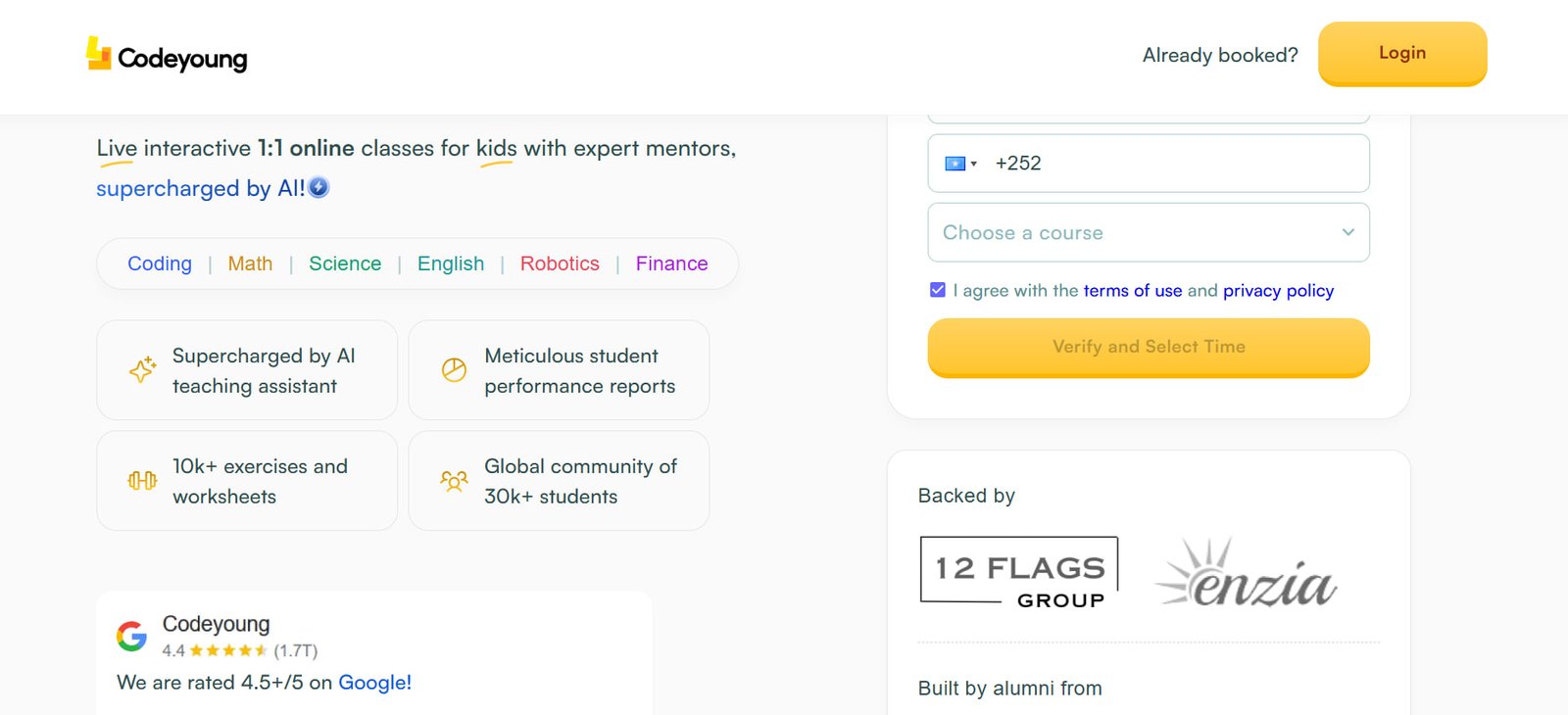
Codeyoung is an online learning platform that provides live classes for children with a strong focus on personalized instruction. Its programs cover subjects including coding, mathematics, science, English, robotics, and finance. Instead of relying only on prerecorded lessons, Codeyoung focuses on live interaction between students and mentors.
For parents researching online education in 2026, understanding how this type of learning works can make it easier to decide whether it fits their child’s needs.
[ Explore Codeyoung’s Online Classes]
What Is Codeyoung?
Codeyoung is an online education platform designed for children who want to develop academic, technology, and practical skills through live online classes.
The platform offers one-to-one learning with mentors, allowing lessons to be adjusted according to a student’s level, interests, and learning pace. Its subject areas include coding, mathematics, science, English, robotics, and financial literacy.
The idea behind personalized online education is simple. Children do not all learn at the same speed.
One student may understand a new concept immediately, while another student may need additional examples and practice. In a large classroom, it can be difficult for a teacher to spend extra time with one individual student. A one-to-one online class creates more room for personalized attention.
This can be particularly useful for subjects such as coding and mathematics, where students often need to understand one concept before moving to the next.
Codeyoung also combines live teaching with technology-supported learning activities. This creates an educational environment where students can communicate directly with their mentors while also using digital exercises and learning resources.
For parents, this means online education does not necessarily have to mean sitting alone in front of a prerecorded video.
How Does Codeyoung Online Learning Work?
The online learning process is designed to be straightforward.
Parents can explore the available subjects, select a course that matches their child’s interests, and arrange an introductory or trial learning experience where available.
The live format gives students an opportunity to interact directly with a mentor during their lessons.
A typical online class can include explanations, questions, exercises, practical activities, and feedback.
This is particularly useful for children who have questions during a lesson. Instead of waiting until the next class or trying to find an answer independently, they can ask their instructor immediately.
The learning process can also become more personalized over time.
For example, if a student already understands basic coding concepts, the mentor can spend less time explaining introductory material and focus on more challenging projects. If another student needs more practice, the instructor can slow down and provide additional examples.
That flexibility is one of the main differences between personalized online education and completely self-paced learning.
Why One-to-One Online Classes Matter
One-to-one learning has become an increasingly interesting option for parents because children have different educational needs.
A student who performs well in mathematics may struggle with English. Another child may be highly interested in computers but find traditional classroom lessons less engaging.
Personalized instruction gives the mentor more opportunities to understand these differences.
During a live lesson, an instructor can notice when a student is confused, ask questions, provide additional explanations, and adjust the difficulty of an activity.
This can create a more interactive experience than simply watching educational videos.
It also gives students an opportunity to communicate.
Communication is an important part of learning because children need to feel comfortable asking questions. If a child is afraid of making a mistake, they may avoid participating. A supportive mentor can encourage students to experiment, make mistakes, and learn from them.
Online learning therefore works best when technology and human interaction work together.
Codeyoung Coding Classes for Kids
Coding is one of the main areas associated with Codeyoung.
Technology is becoming a larger part of everyday life, and children are growing up surrounded by smartphones, applications, websites, artificial intelligence, and digital services.
Learning coding does not necessarily mean that every child needs to become a professional software developer.
Programming can also teach children how to think through problems.
When students write code, they learn how to break a large problem into smaller steps. They learn to test ideas, identify mistakes, and try different solutions.
These skills can be useful outside programming as well.
Codeyoung provides coding programs for different ages and experience levels. Younger students can begin with visual programming and basic programming concepts before progressing toward more advanced technologies.
Students can learn concepts such as sequences, loops, conditions, variables, logic, and problem solving.
As they gain confidence, they can explore technologies such as Python, JavaScript, web development, and other programming tools.
Project-based learning can make coding more interesting because children are able to see what they are creating.
Instead of simply memorizing programming commands, students can work toward building something.
For example, a student might create a simple game, website, animation, or interactive project. Completing a project can give children a sense of achievement and show them how programming concepts are used in practice.
See Codeyoung Coding Classes for Kids
Mathematics and Personalized Learning
Mathematics is another area where personalized instruction can be valuable.
Math is often cumulative. A child who has difficulty understanding one concept may find later lessons increasingly challenging.
For example, students need to understand basic arithmetic before moving into more complex mathematical topics. Similarly, algebraic concepts often depend on earlier knowledge.
A personalized online class allows a mentor to identify areas where a student may need additional practice.
Rather than moving forward simply because the rest of a class has moved forward, the instructor can spend more time explaining a difficult concept.
This can make online tutoring useful as a supplement to traditional school education.
Parents do not necessarily have to think of online learning as a replacement for school. It can also provide additional practice, support, or advanced learning outside the regular classroom.
For students who enjoy mathematics, personalized instruction can also provide opportunities to explore more challenging problems.
Science Classes for Children
Science is another important part of modern education.
Children are naturally curious about the world around them. They want to understand why things happen, how nature works, and how technology is created.
Online science classes can provide structured opportunities to explore these questions.
Depending on the program, students can study areas such as life science, physical science, Earth science, space, and engineering-related concepts.
The challenge with online science education is keeping lessons interactive.
Children generally learn better when they can participate rather than simply listen.
A live instructor can ask questions, demonstrate concepts, discuss examples, and encourage students to think critically.
This approach can make science more engaging than simply reading information from a textbook.
English and Communication Skills
English is another area where live instruction can provide useful interaction.
Language learning involves more than memorizing vocabulary.
Students need opportunities to communicate, read, write, listen, and express their ideas.
A live instructor can create conversations and activities that encourage students to participate.
For children learning English as an additional language, speaking practice can be particularly important.
The ability to communicate clearly is useful not only at school but also later in higher education and professional environments.
That makes communication skills an important part of a broader education strategy.
Robotics and Technology Education
Robotics combines several different skills.
Students can learn about programming, engineering, problem solving, and technology while working toward practical projects.
For children who enjoy building things, robotics can be an engaging way to learn.
Instead of studying programming only through abstract examples, students can see how instructions can control actions and produce results.
Robotics also introduces the idea that technology involves both software and hardware.
This can encourage children to think about how the digital and physical worlds interact.
As technology continues to develop, understanding basic concepts behind automation and robotics may become increasingly useful.
Financial Literacy for Kids
Financial education is another interesting area of children’s learning.
Traditional school programs do not always spend a significant amount of time teaching children how money works in everyday life.
Financial literacy can introduce concepts such as saving, spending, budgeting, financial responsibility, and decision-making.
Teaching these concepts early can help children develop a basic understanding of how financial decisions affect their lives.
The goal does not need to be teaching children complicated financial products.
Instead, simple concepts can help young people develop responsible habits.
Learning how to distinguish between needs and wants, understanding the importance of saving, and learning to plan spending are useful life skills.
How Technology Is Changing Online Education
Artificial intelligence has become one of the biggest developments in education and technology.
Modern learning platforms can use technology to provide exercises, feedback, assessments, and personalized learning experiences.
Codeyoung also highlights AI-supported features as part of its educational approach.
However, technology should not necessarily replace teachers.
The most useful role for technology can be to support human instruction.
For example, a student may complete an online exercise and receive immediate feedback. The mentor can then review the student’s performance and explain areas that remain difficult.
This combination can provide both convenience and human guidance.
The teacher remains responsible for communication and explanation, while technology can help provide additional practice and information.
This blended approach is likely to remain an important part of online education.
The Importance of the Mentor
Technology is only one part of the learning experience.
The quality of the interaction between the student and mentor also matters.
Children have different personalities and preferences.
Some students enjoy asking questions constantly. Others need encouragement before they participate. Some prefer practical projects, while others enjoy detailed explanations.
A good mentor needs to recognize these differences.
The relationship between student and teacher can influence how comfortable the child feels during the lesson.
If students are comfortable asking questions, they may be more willing to admit when they do not understand something.
That can help the mentor identify problems earlier.
Parents should therefore pay attention to the instructor during a trial class or introductory session.
The important question is not only whether the teacher knows the subject.
Parents should also consider whether the teacher communicates clearly and whether the child feels comfortable learning with that instructor.
Who Can Benefit From Codeyoung?
Online personalized education can be useful for different types of students.
Beginners
Children who have never studied coding or another technology subject can start with introductory concepts.
Students Who Need Additional Support
Some children need more practice with mathematics, science, English, or other subjects outside regular school hours.
Technology-Oriented Students
Children who already enjoy computers, games, applications, or technology may find coding and robotics particularly interesting.
Independent Learners
Students who enjoy exploring new subjects can use structured classes to develop their skills further.
Busy Families
Online classes can be convenient for families that want educational programs without traveling to a physical learning center.
However, every child is different.
Parents should consider the child’s interests, schedule, personality, and learning preferences before choosing an online program.
What Parents Should Consider Before Enrolling
Choosing an online learning program should involve more than looking at the course title.
There are several practical questions parents should ask.
1. What Does My Child Want to Learn?
A child’s interest can make a significant difference.
If the child loves computers, coding may be a natural choice.
If the child enjoys science experiments, a science program may be more appropriate.
The learning program should match the child’s interests whenever possible.
2. How Much Time Is Available?
Online education requires consistency.
Parents should look at the schedule and determine whether regular lessons fit comfortably into the child’s routine.
A realistic schedule is more sustainable than choosing too many classes at once.
3. Does My Child Like Online Learning?
Some children adapt quickly to online classes.
Others prefer physical classrooms.
Parents should observe how their child responds to the online environment.
4. Does the Mentor Communicate Well?
The teacher-student relationship is important.
Parents should pay attention to whether the instructor explains concepts clearly and encourages participation.
5. What Happens After the Trial?
Before purchasing a longer program, parents should review the current pricing, schedule, cancellation terms, course structure, and enrollment conditions.
These details can change over time, so checking the current information directly is important.
Codeyoung Pricing and Trial Classes
The cost of an online education program can vary depending on the subject, course, number of classes, and current promotions.
For that reason, parents should check the latest information before making a purchase.
Codeyoung also offers a trial experience for families interested in exploring its classes.
A trial can be particularly useful because parents do not have to rely entirely on descriptions.
They can see how the online classroom works and observe how their child responds to the instructor.
A student may discover that coding is more interesting than expected.
Another student may realize that mathematics becomes easier when someone explains the concept individually.
This type of experience can help families make a more informed decision.
[ Book a Free Codeyoung Trial Class]
Codeyoung Compared With Self-Paced Online Courses
There are many different ways for children to learn online.
Self-paced courses are convenient because students can often watch lessons whenever they have time.
Educational videos can also be useful when a child needs a quick explanation of a specific concept.
Mobile applications can provide exercises and quizzes.
Live one-to-one education is different.
The student has a scheduled class, an instructor is present, and the lesson can respond to the student’s questions and performance.
Each model has advantages depending on the learner.
A highly independent student may be comfortable with self-paced material.
A student who needs accountability or personal explanations may prefer live classes.
The important thing is matching the learning format with the child’s needs.
The Role of Parents in Online Learning
Parents still play an important role even when education takes place online.
A parent does not necessarily need to sit next to the child throughout every class.
However, checking progress and asking about the learning experience can be helpful.
Parents can ask questions such as:
“What did you learn today?”
“What was the most interesting part?”
“Was anything difficult?”
“What would you like to learn next?”
These simple conversations can help children think about their learning.
Parents can also make sure that the child has a quiet environment, reliable internet access, and the necessary equipment for online classes.
Creating a consistent routine can make online learning easier.
Why Coding Skills Matter in 2026
The digital economy continues to change.
Artificial intelligence, automation, software, robotics, cloud computing, and digital businesses are becoming increasingly visible across many industries.
Children do not necessarily need to become programmers to benefit from understanding technology.
Coding can teach logical thinking and problem solving.
It can show children that complicated problems can be divided into smaller tasks.
It can also teach persistence.
When a program does not work, the student has to investigate what went wrong and try again.
That process can help develop patience and analytical thinking.
The earlier goal should not necessarily be employment.
The goal can simply be helping children become more comfortable with technology and understand how digital systems are created.
Building Skills Beyond the Classroom
One of the most valuable aspects of modern education is helping children develop skills that can be used outside a classroom.
Coding can support problem solving.
Mathematics can develop analytical thinking.
Science can encourage curiosity.
English can improve communication.
Financial literacy can support responsible decision-making.
Robotics can combine technical and creative skills.
When these subjects are presented in an engaging way, children can begin to see connections between different areas of knowledge.
For example, a student learning coding may become interested in building a website.
That website could lead to an interest in design, marketing, entrepreneurship, or digital business.
Education can therefore become the starting point for exploring many different areas.
Final Thoughts
Choosing an online education platform is a decision that should be based on the individual needs of the child.
There is no single learning system that works perfectly for every student.
However, personalized online education can provide an alternative for families looking for live instruction, flexible learning, and additional academic or technology-focused support.
Codeyoung offers courses across several areas, including coding, mathematics, science, English, robotics, and financial literacy.
Its focus on live one-to-one classes makes it different from purely self-paced educational websites.
For parents interested in coding or personalized online learning, exploring the available programs and trying an introductory class can be a practical way to understand whether the platform fits their child’s needs.
The most important questions are simple:
Does the course match the child’s interests?
Does the teaching style work for the child?
Is the schedule convenient?
Does the child enjoy the learning experience?
And most importantly, does the program help the child become more curious and confident about learning?
For families who are exploring these questions, Codeyoung can be one of the online education platforms worth researching.