


Building a solid credit history in the United States is one of the most critical steps toward financial freedom. Without a good FICO score, everyday milestones like renting a premium apartment, financing a reliable car, or getting approved for a low-interest credit card become massive financial hurdles.
For a long time, consumers with a “thin file” or a damaged credit report had very few options to build credit safely. Traditional credit card issuers routinely denied their applications, and loan providers charged predatory interest rates.
Today, financial technology (FinTech) has completely rewritten the rules of personal finance. Two massive platforms dominate the credit-building ecosystem in 2026: Kovo Credit Builder and Self Credit Builder (formerly Self Lender). Both platforms promise a guaranteed approval path with no hard credit checks, making them highly attractive to credit beginners and individuals recovering from past financial mistakes.
However, while their ultimate goal is identical—injecting positive payment data into your credit bureau files—their internal financial mechanics, pricing structures, and overall risks are completely different.
In this comprehensive, data-driven Kovo vs. Self comparison guide, we will dissect exactly how both platforms operate, look at their hidden costs, map out their bureau reporting networks, and determine which credit builder will increase your score faster based on your unique financial situation.
Quick Summary: The Primary Difference
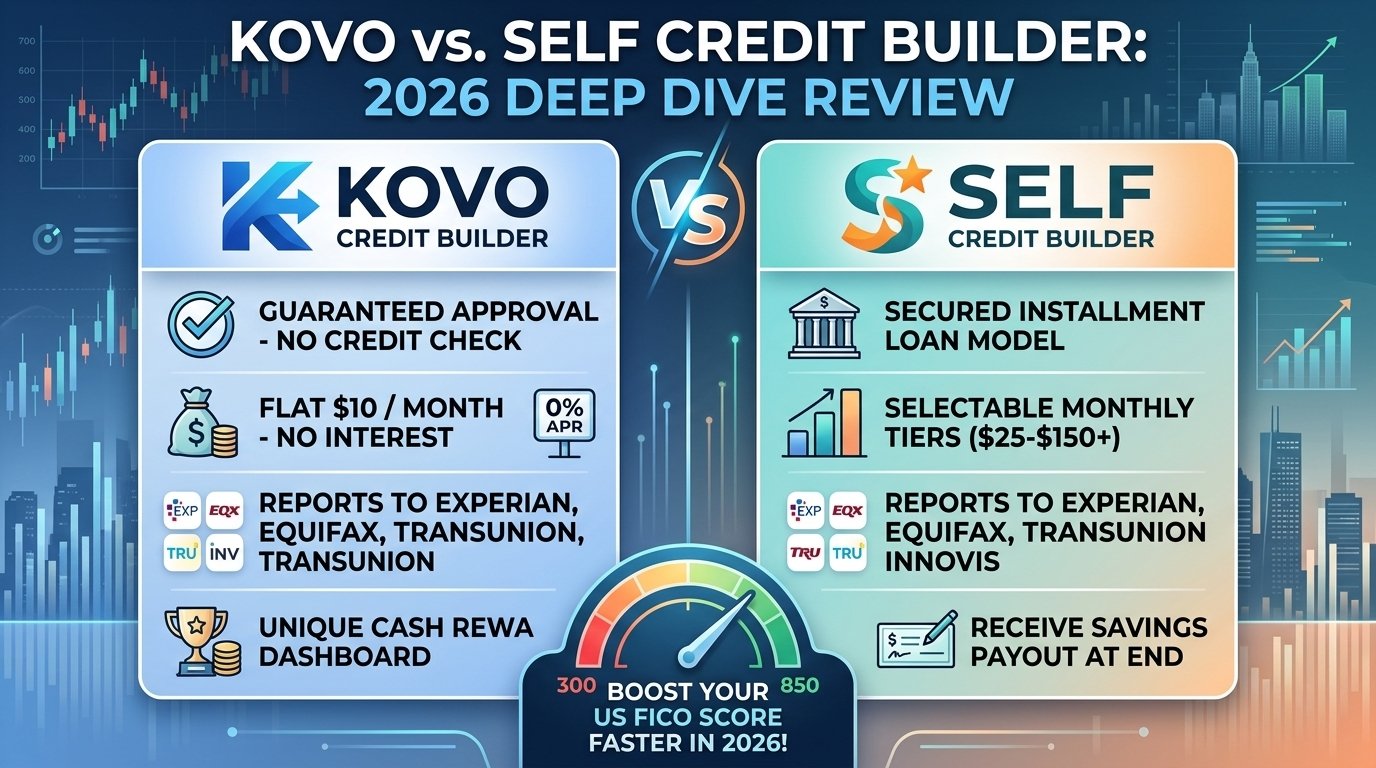
- Kovo Credit Builder is an installment credit service wrapped around an e-learning marketplace. You pay a flat $10 a month for 24 months to purchase digital courses, with 0% interest and no hidden fees, while building a flawless payment record.
- Self Credit Builder operates on a credit-builder loan model held in a locked certificate of deposit (CD). You save a fixed amount each month (ranging from $25 to $150) and receive your savings back at the end of the term, minus administrative fees and interest charges.
Deep Dive: How Kovo Credit Builder Works
Kovo has built its reputation on simplicity, extreme affordability, and fixed structural transparency. It is designed specifically for budget-conscious consumers who want a zero-risk credit product.
When you create an account with Kovo, you are technically purchasing a curated bundle of premium educational courses for a total price of $240. Instead of forcing you to pay for this upfront, Kovo sets up an installment plan where you pay $10 per month over a period of 24 months.
Because you are making regular, fixed monthly payments toward a pre-set total balance, the credit bureaus recognize this as an active installment loan / account.
The Key Mechanics of Kovo:
- Guaranteed Approval: There is absolute zero credit checking required to get started. Whether your score is 450 or non-existent, you are approved instantly.
- Comprehensive Bureau Reporting: Kovo reports your monthly payments to Experian, Equifax, TransUnion, and Innovis. This massive coverage ensures your credit file is strengthened across all major lending databases.
- 0% Interest APR: Kovo does not charge interest on your installment account. You pay exactly $10 a month—nothing more, nothing less.
- Integrated Rewards Program: As you make on-time payments, you accumulate points within the Kovo dashboard that can be cashed out directly or used to pay down your balance, lowering your actual net cost.
👉 [CLICK HERE TO JOIN KOVO CREDIT BUILDER AND AUTOMATE YOUR PAYMENT HISTORY FOR $10/MONTH]
Deep Dive: How Self Credit Builder Works
Self takes a more traditional approach by combining credit building with a forced savings mechanism. It is tailored for users who want to build credit while simultaneously accumulating a lump-sum savings account.
When you open a Self Credit Builder Account, you choose a monthly payment tier (typically $25, $35, $48, or $150 a month) and a loan term (usually 12 or 24 months). A partner bank (such as Lead Bank or Sunrise Banks) issues a loan for that total amount and locks the funds securely in a certificate of deposit (CD) under your name.
You do not get access to this loan money immediately. Instead, you spend the next year or two making your chosen monthly payments to pay off the loan.
The Key Mechanics of Self:
- The Big Payout at the End: Every monthly payment you make acts as a deposit into your locked savings. Once your term ends and the loan is fully paid off, the CD unlocks, and Self cuts you a check for your accumulated savings.
- Bureau Reporting: Self reports your payment history monthly to the three primary credit bureaus: Experian, Equifax, and TransUnion.
- The Hidden Cost: Unlike Kovo, Self is not free. You must pay an upfront administrative fee (usually $9), and the loan accumulates interest (APR can range from 12% to over 15% depending on the tier). This means you get back slightly less money than you put in.
Head-to-Head Comparison: Kovo vs. Self
To see exactly how these two personal finance tools stack up against each other, let’s look at a detailed feature-by-feature matrix.
Comparison Matrix
| Feature Comparison | Kovo Credit Builder | Self Credit Builder |
|---|---|---|
| Monthly Financial Commitment | Flat $10 / Month | $25, $35, $48, or $150 / Month |
| Hard Inquiry / Credit Check | No | No |
| Upfront Administrative Fee | None ($0) | $9 Activation Fee |
| Interest Rate / APR | 0% APR (No Interest Charges) | Up to 15.92% APR |
| Credit Bureaus Reported To | Experian, Equifax, TransUnion, Innovis | Experian, Equifax, TransUnion |
| Account Type on Credit Report | Installment Loan / Account | Secured Installment Loan |
| What You Get At the End | Premium E-Courses + Cash Rewards | Your accumulated savings minus fees |
Which One Boosts Your FICO Score Faster?
To determine which platform delivers a faster score increase, we have to look closely at the mathematical mechanics of the FICO Score model. Payment History accounts for 35% of your total credit score, and both Kovo and Self target this specific component flawlessly by reporting 100% on-time monthly installments.
However, Kovo holds two distinct structural advantages that can result in a more efficient score boost for certain profiles:
1. Bureau Coverage (4 vs. 3 Platforms)
Self reports exclusively to the “Big Three” bureaus (Experian, Equifax, and TransUnion). Kovo reports to the Big Three plus Innovis.
Innovis is rapidly expanding in the United States as an alternative credit database heavily utilized by independent auto lenders, regional utilities, and modern property management groups. By including Innovis in its monthly reporting run, Kovo ensures that your positive payment footprint is woven into a wider, more bulletproof web of consumer databases.
2. Ultra-Low Financial Stress (Removed Risk of Defaults)
A credit-builder product only works if you never make a late payment. Because Self requires a higher monthly payment ($25 to $35 minimum), users managing tight budgets run a higher risk of defaulting or making a late payment if an unexpected emergency arises. A single late payment reported to the bureaus can instantly drop your score by up to 100 points, completely reversing your progress.
Kovo’s micro-payment model ($10 a month) is incredibly easy to maintain via automated deductions. It carries virtually zero financial strain, drastically lowering the risk of accidental late payments.
👉 [START A RISK-FREE $10 CREDIT BOOST CONTRACT WITH KOVO HERE]
Pros and Cons Analysis
An objective personal finance evaluation requires analyzing the strengths and trade-offs of both options.
Kovo Pros:
- Unrivaled Affordability: At $10 a month, it is the most wallet-friendly installment credit trade line on the market.
- Absolute Zero Fees: No activation costs, no maintenance charges, and zero interest accumulated.
- Immediate Career Value: The digital courses provide actionable blueprints for digital marketing, budgeting, and online entrepreneurship.
Kovo Cons:
- No cash payout at the end of the 24-month installment contract.
Self Pros:
- Forced Savings Mechanism: Forces you to accumulate a lump-sum nest egg that is returned to you at the end of the term.
- Flexible Tiers: Allows high-income users to opt for the $150/month tier if they want to build a larger savings account quickly.
Self Cons:
- Wealth-Degrading Fees: Charges an upfront fee and extracts interest, meaning you lose money over the course of the loan contract.
- Higher Entry Barrier: Requires a larger monthly budget commitment compared to modern alternative FinTech options.
The Strategic Verdict: Which Should You Choose?
The decision between Kovo and Self ultimately comes down to your primary personal finance goal and your monthly budget availability:
Choose Kovo Credit Builder If:
- You want the lowest possible cost: You want to build bulletproof payment history across 4 bureaus without paying interest or upfront activation fees.
- You prefer automated, zero-risk credit health: You don’t want the financial pressure of a $30+ monthly loan bill and prefer a predictable $10 micro-installment.
- You are interested in self-improvement: You want to access premium e-learning modules to upgrade your professional skills while fixing your credit profile.
👉 [CHOOSE THE HIGH-EFFICIENCY ROUTE: SIGN UP FOR KOVO CREDIT BUILDER TODAY]
Choose Self Credit Builder If:
- You struggle with saving money: You need a strict, forced mechanism to help you save a lump sum of money over 12 or 24 months.
- You don’t mind paying interest fees: You are comfortable losing a small portion of your money to interest charges and administrative fees in exchange for receiving a cash payout check at the end of the loan term.
Final Words of Advice for US Consumers
Whether you select the streamlined digital bundle of Kovo or the traditional savings CD of Self, the most critical step is taking immediate action. A strong credit score requires time, consistency, and a flawless payment record. By automating your credit journey today with a dedicated installment tool, you are securing massive long-term savings on future mortgages, auto loans, and premium credit lines.