

UTM naming conventions are the fixed rules a team uses to write consistent tracking parameters on every marketing link, so campaign data rolls up cleanly instead of splintering into duplicate rows. The core rule: treat UTMs as a controlled taxonomy, not a free-for-all. Lock utm_source and utm_medium into approved lists, standardize your syntax, and enforce both with a lightweight review process before links ever go live.
TL;DR:
- Consistent lowercase formatting and a single separator are essential to prevent duplicate entries and ensure accurate reports.
- Using a clear, time-first naming pattern for campaigns helps maintain proper sorting and reduces the risk of reuse mistakes.
- Relying on closed lists for source and medium values, validated through a designated builder, minimizes typos and reporting fragmentation.
- Avoid putting UTMs on internal links, as they overwrite original sources and erase accurate attribution data.
- Regular ownership, review, and updates of the UTM registry are crucial to sustain a reliable and trustworthy tracking system.
Table of Contents
- What Are UTM Naming Conventions and Why Do They Matter?
- Which UTM Naming Model Should You Choose?
- Syntax Rules That Prevent Data Fragmentation
- How Do You Map Campaign Names to UTM Parameters?
- What Do UTM Templates Look Like by Channel?
- Who Should Own Your UTM Governance and Audit Process?
- Why Do UTM Reports Keep Breaking, and How Do You Fix It?
- How Should You Roll Out a New UTM Convention?
- What Marketing Teams Get Wrong About UTM Discipline
- Get Your UTM Taxonomy Built and Enforced
- Where to Read More on UTM Governance
- Sources
- FAQ
What Are UTM Naming Conventions and Why Do They Matter?
UTM naming conventions are the agreed-upon rules for writing the five tracking parameters that attach to a URL: utm_source, utm_medium, utm_campaign, utm_content, and utm_term. Get sloppy with them and your analytics platform can’t tell that “Facebook,” “facebook,” and “FB” are the same channel. That’s not a hypothetical. It’s the single most common reason marketing dashboards show ten “sources” for a channel that should have three.
Here’s how the five parameters actually function, and which ones need strict rules versus creative freedom.
- utm_source: the platform sending the traffic (google, linkedin, newsletter). These should be a closed list, meaning marketers pick from an approved set instead of typing freely.
- utm_medium: the channel type (cpc, paid_social, email, referral). Also closed list. If your medium list has more than ten or twelve values, something is being duplicated.
- utm_campaign: the specific initiative (spring_sale_2026, product_launch_q2). This stays descriptive and can flex per campaign, as long as it follows a naming pattern.
- utm_content: differentiates creative, placement, or audience segment within the same campaign (headline_a, sidebar_banner, retargeting_25_34).
- utm_term: traditionally used for paid search keywords, though some teams repurpose it for audience segments in social campaigns.
Source and medium behave like dimensions in a database schema. If you let people write whatever they want in those two fields, every report downstream inherits the mess. Campaign and content, by contrast, need room to describe what’s actually happening in a given push, so they work better as structured free text than rigid dropdowns. Getting this split right is the foundation everything else in your UTM taxonomy builds on, because source and medium feed the channel grouping your analytics platform uses to bucket traffic. Get those two fields wrong and the bucketing is wrong for every session downstream.
Which UTM Naming Model Should You Choose?
Once the five parameters are defined, you have to decide how to structure the values inside utm_campaign and utm_content. Three models dominate, and most mature teams end up running a hybrid of two.
- Cryptic (ID-based). Values are short codes tied to a lookup table, like
utm_campaign=c4471. This keeps URLs short and prevents typos in the URL itself, but it’s unreadable without the lookup table open. A campaign namedc4471tells a human nothing. Good for teams with heavy automation and a strict content management layer; bad for anyone who needs to eyeball a report and understand it instantly. - Positional (fixed segments). Values follow a strict order separated by underscores, like
utm_campaign=2026q1_launch_us_paid. Each position means something specific (year/quarter, initiative, region, tier), and everyone on the team memorizes the order. This scales well and reads reasonably in reports, but it breaks if someone forgets a segment or inserts one out of order. - Key-value (semantic). Each segment is labeled inline, like
utm_campaign=q1-2026_launch_region-us_tier-paid. It’s more verbose but self-documenting. Anyone can read the string cold and know exactly what each part means, without a lookup table or a memorized schema.
Here’s the same spring product launch written in each model:
- Cryptic:
utm_campaign=c0892 - Positional:
utm_campaign=2026q2_launch_us_paid - Key-value:
utm_campaign=launch-widgetx_q2-2026_region-us
Most practitioner guidance recognizes these as the three main naming models, and the choice usually comes down to team size and reporting maturity rather than any one model being objectively better. Small teams doing manual reporting in a spreadsheet do fine with positional. Teams pulling UTM data into a BI tool that needs to parse segments programmatically often lean key-value, because the labels double as parsing anchors. Hybrids are common: positional for campaign structure, key-value for content differentiation, because content values tend to need more description than a rigid position allows. If you’re migrating from a cryptic system, don’t try to backfill every historical campaign. Start the new model on a fixed date and keep the old codes readable in a lookup archive.
Syntax Rules That Prevent Data Fragmentation
Most UTM fragmentation has nothing to do with strategy. It’s typos, capitalization, and formatting drift. A handful of hard syntax rules eliminates most of it before it starts.
- Lowercase everything, always.
Facebookandfacebookregister as two different sources in most analytics tools. Enforce lowercase at the builder level so no one has to remember it. - Pick one separator and never mix it. Underscores or hyphens, not both. Mixing them inside the same parameter is one of the fastest ways to fracture a report, because
spring_saleandspring-saleare not the same string to a machine. - Stick to letters, numbers, and your chosen separator. Skip spaces, punctuation, and special characters. Spaces get URL-encoded into
%20and show up ugly in reports and shared links. - Format dates the same way every time.
2026_q2or20260401, never a mix of both across campaigns. - Abbreviate only where the abbreviation is on the approved list.
paid_socialbeatspsbecause six months later, nobody remembers whatpsmeant.
On the encoding side, watch what redirects do to your query strings. Link shorteners, tracking pixels, and some e-commerce platforms strip or re-encode UTM parameters during a redirect chain, which silently breaks attribution even when the original link was written correctly. Test every link template through its actual production path, not just in a browser address bar.
Pro Tip: Run one test click through your full redirect chain (shortener, landing page, any tag manager rules) and check the parameters actually arrive intact in your analytics platform before you send a campaign live. This catches more errors than any amount of careful typing.
A lightweight QA checklist that verifies parameters survive redirects and land in the right dimensions catches most launch-day errors for close to zero effort. It takes minutes and it’s the difference between clean data and a week of cleanup later.
How Do You Map Campaign Names to UTM Parameters?
Your campaign naming schema and your UTM structure should be the same system, described twice. If marketing calls something “Q2 Product Launch, US Market, Paid Tier” internally, the UTM should encode exactly that, not a different shorthand invented on the fly by whoever built the link that week.
The most durable pattern starts with time, then narrows: [timeframe]_[initiative]_[region]_[tier]. Date-first or quarter-first prefixes matter more than they seem to at a glance, because they make historical campaigns sort correctly and stop teams from accidentally reusing a name for something unrelated a year later. This is a small rule that pays off disproportionately in reporting hygiene once a team has a few years of campaign history stacked up.
Mapping from your internal taxonomy to actual UTM fields usually looks like this:
| Internal concept | Maps to | Example value |
|---|---|---|
| Campaign initiative | utm_campaign | 2026q2_launch_widgetx |
| Sending platform | utm_source | |
| Channel type | utm_medium | paid_social |
| Creative or placement | utm_content | carousel_ad_v2 |
| Keyword or segment | utm_term | retargeting_25_34 |
The tradeoff is granularity versus readability. You can encode region, tier, language, and audience segment all into utm_campaign, and some enterprise teams do exactly that. But every extra segment you add is another place for someone to make a typo, and another column your analyst has to split out later. A workable rule of thumb: keep utm_campaign to three or four segments max. If you need more dimensions, push them into utm_content or utm_term instead of cramming everything into one field. Reports stay readable, and nobody has to memorize a ten-part string to write a link correctly.
What Do UTM Templates Look Like by Channel?
Every channel has its own quirks, and copying one template across all of them is how internal tagging errors and mixed source/medium pairs creep in.
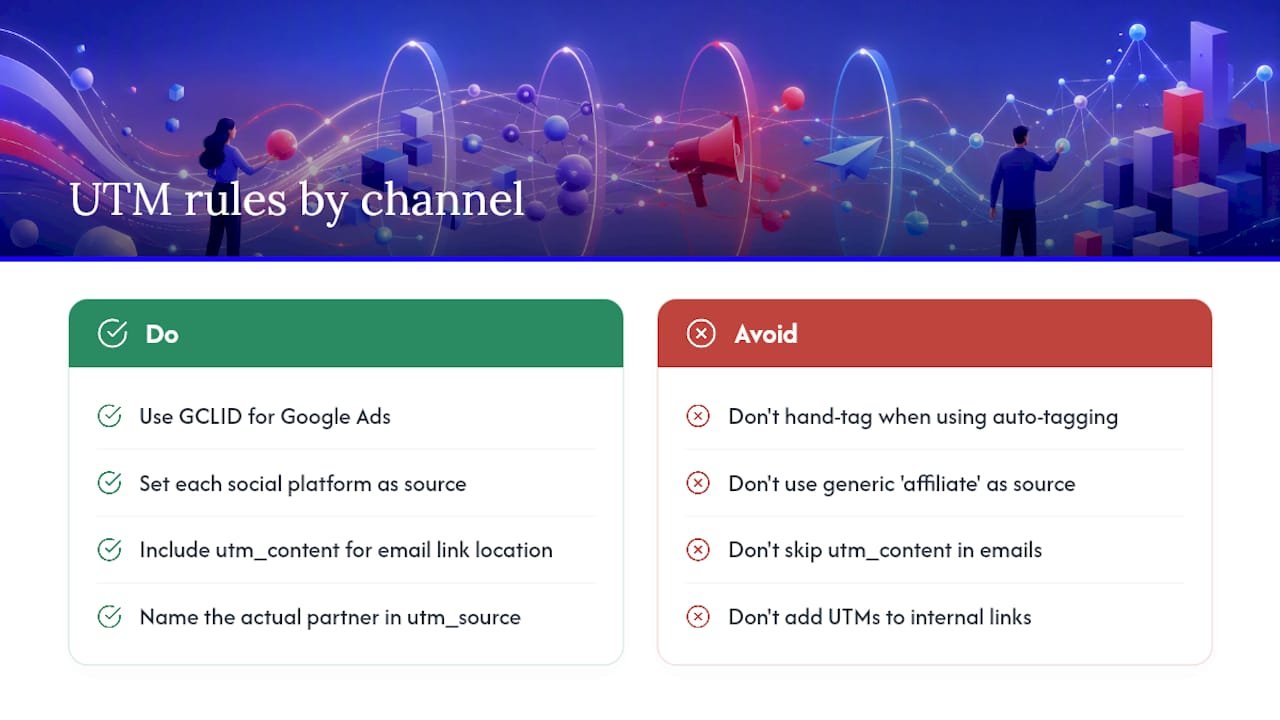
Paid search. For Google Ads specifically, don’t hand-tag with UTMs at all if you’re relying on auto-tagging. Google’s own GCLID parameter carries richer attribution data than a manual UTM string, and layering manual tags on top of auto-tagging creates conflicting records in your analytics tool. This is one of the more overlooked common mistakes in paid search tracking. If you’re running search on a platform without auto-tagging, a workable template is utm_source=bing&utm_medium=cpc&utm_campaign=2026q2_launch_us&utm_term=widget+comparison.
Paid social. Each platform is its own source. utm_source=linkedin&utm_medium=paid_social&utm_campaign=2026q2_launch_us&utm_content=carousel_v2. The gotcha here is utm_medium: some teams write “social” for organic posts and “paid_social” for ads, and some write “social” for both and rely on utm_source to differentiate. Pick one system and hold every platform to it.
Email. utm_source=newsletter&utm_medium=email&utm_campaign=2026q2_launch_us&utm_content=header_cta. The recurring error in email is skipping utm_content entirely, which makes it impossible to tell your header link from your footer link in the same send. If you’re A/B testing subject lines or CTAs, utm_content is where that distinction has to live.
Partnerships and affiliates. utm_source=partnername&utm_medium=partnership&utm_campaign=2026q2_launch_us&utm_content=blog_review. Naming the actual partner in utm_source rather than a generic “affiliate” tag is what lets you compare individual partners against each other later. Generic tagging here is one of the fastest ways to lose the ability to evaluate which partnerships are actually paying off.
Offline to online (QR codes, print). utm_source=print_flyer&utm_medium=offline&utm_campaign=2026q2_launch_us&utm_content=storefront_qr. This is the one place teams forget UTMs entirely, because there’s no digital ad platform prompting them to add tracking. Any QR code, printed URL, or event badge should carry the same UTM discipline as a digital ad.
One rule cuts across every channel: never put UTM parameters on internal links (nav menus, footer links, in-app links to your own site). Doing so overwrites the visitor’s original source with your own site as the referrer, which erases the attribution you were trying to protect in the first place.
Who Should Own Your UTM Governance and Audit Process?
A naming convention without an owner degrades within a quarter. Someone forgets the rule, someone else copies an old link instead of building a new one, and drift compounds fast. Effective governance needs four concrete pieces.
- A named owner. Usually someone on the marketing operations or analytics team, not a committee. One person approves changes to the approved-values list and fields questions when a new campaign type doesn’t fit the existing schema.
- An approved-values registry. A living document or spreadsheet listing every valid
utm_sourceandutm_medium, with definitions. New values go through a short request process instead of getting invented ad hoc by whoever is building a link that day. - A builder with validation. A simple form with dropdowns for source and medium, and a template field for campaign, beats a blank text box every time. Governance guidance consistently points to this kind of lightweight tooling as the highest-leverage fix a team can make, because it removes the chance for typos at the point of creation rather than catching them after the fact.
- A review cadence. Monthly quick checks catch obvious drift (a new source that snuck in, a medium that’s drifting toward duplication). Quarterly reviews are the time to retire stale campaign values and confirm the approved list still matches how the team actually markets.
Pro Tip: Put your approved-values list inside the actual link builder, not in a separate document nobody opens. A dropdown that only shows the twelve approved mediums prevents more errors than any style guide ever will.
Communicate every change to the registry the same way you’d announce a change to a shared style guide: a short note in the team channel, with the effective date and what changed. Silent changes are how half your team ends up using the old convention six months after everyone thought the new one was live.
Why Do UTM Reports Keep Breaking, and How Do You Fix It?
Four failure modes account for most of the mess in a typical UTM export.
- Internal tagging. Someone puts UTM parameters on a link between two pages of the same site, overwriting the visitor’s real source. Fix: audit your own site for UTM-tagged internal links and strip them.
- Mixed source and medium. Someone treats “email” as a source instead of a medium, or writes the platform name into
utm_medium. Fix: the closed-list registry above prevents most of this at the point of creation. - Duplicate mediums. “Social,” “paid-social,” and “paidsocial” all show up as separate rows because three different people wrote three different versions of the same medium. Fix: an alias map in your reporting layer that maps known variants to one canonical value, without touching the raw historical data.
- Overloaded utm_content. One field trying to carry creative version, audience segment, and placement all at once, making it unparseable later. Fix: split those into
utm_contentandutm_term, or add a documented delimiter convention that your reporting tool can split on.
Spotting these in an analytics export is usually a matter of pulling a distinct-values list for utm_source and utm_medium and scanning for near-duplicates. If your list of mediums has more than fifteen entries, you almost certainly have duplication rather than fifteen genuinely distinct channels. The documented mistakes that show up most often in practitioner audits are exactly these four, which is why they’re worth checking first before assuming a deeper tracking problem.
Once you’ve found the variants, build an alias table in your ETL layer or reporting tool that maps each historical variant to its canonical value. Don’t rewrite the raw data; preserve the original strings for provenance and apply the mapping at the reporting layer instead, so you can always trace a cleaned row back to what was actually sent.
How Should You Roll Out a New UTM Convention?
Rolling out a new convention across an entire marketing team at once is how you get half-hearted compliance and a dozen questions nobody has time to answer. A phased rollout works better.
- Pilot with one channel. Pick paid social or email, whichever has the most active campaign volume, and run the new convention there for two to four weeks. This surfaces edge cases the schema didn’t anticipate before it’s live everywhere.
- Build training materials and a launch checklist. A one-page reference sheet with the approved values, the syntax rules, and three or four worked examples covers most of what a new team member needs.
- Decide how to handle legacy tags. Map old campaign names to new canonical values in your reporting layer rather than rewriting historical UTMs at the source, which preserves the ability to trace a report back to what was actually sent at the time.
- Schedule a remediation review. Thirty to sixty days after full rollout, check the distinct-values list again. A shrinking count of duplicate sources and mediums is the clearest sign the new convention is holding.
Measure the improvement in the same query you used to diagnose the original mess. Fewer near-duplicate values in your source and medium columns is a concrete, checkable sign that governance is actually working, not just documented.
What Marketing Teams Get Wrong About UTM Discipline
Most teams treat UTM naming as a one-time setup task. Write the rules, share a document, move on. That’s backwards. A naming convention is a living taxonomy that needs the same ongoing attention as any other shared system your team depends on, and the teams that get real value from it are the ones that revisit it on a schedule rather than writing it once and forgetting it exists.
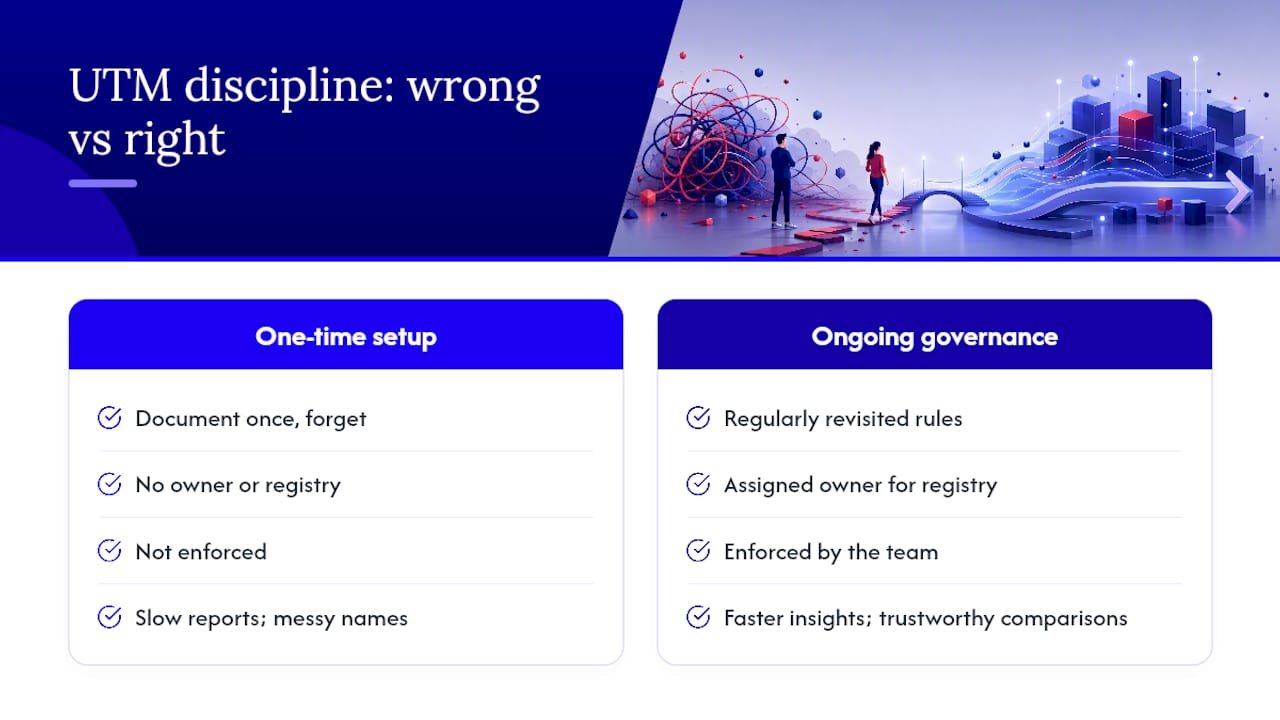
The outcome we consistently see when a team actually enforces this, rather than just documenting it, is faster time-to-insight. Analysts stop spending the first hour of every report cleaning duplicate channel names, and campaign comparisons become trustworthy instead of “roughly right.” That’s not a small thing when leadership is making budget calls off those reports.
The uncomfortable truth is that most naming convention failures aren’t technical. They’re organizational. Nobody owns the registry, nobody enforces the builder, and the rules live in a document that everyone agreed to once and nobody has opened since. Fix the ownership problem and the technical rules mostly take care of themselves.
— Teermo
Get Your UTM Taxonomy Built and Enforced
Reading a naming convention guide is one thing. Building the registry, wiring up a builder with real validation, and training a team to actually use it is a different project entirely, and it’s usually the part that stalls out after the initial planning meeting.

Teermoonline works directly with marketing teams on exactly this kind of implementation: taxonomy design that maps to your actual campaign structure, a URL builder configured with your approved-values list, governance training so the rules survive staff turnover, and periodic audit engagements to catch drift before it compounds into months of cleanup. The typical starting point is a short assessment of your current UTM data to see how much fragmentation already exists, followed by a pilot on one channel before rolling the convention out everywhere. If your reporting has reached the point where nobody fully trusts the channel breakdown anymore, that assessment is the fastest way to find out exactly how bad it is and what it takes to fix it. Reach out to Teermoonline to talk through where your tracking stands today.
Where to Read More on UTM Governance
For deeper detail beyond this guide, a few sources are worth bookmarking. Improvado’s breakdown of naming models covers cryptic, positional, and key-value structures with more worked examples than fit here. Utility Link’s taxonomy guide is the clearest resource on separating strategy from syntax and building a QA process around it. Kissmetrics’ piece on taxonomy that survives to revenue is the sharpest explanation of why closed lists matter and how Google Ads auto-tagging interacts with manual UTMs. Utilkit’s governance guide focuses specifically on ownership models and review cadence, which is the part most teams skip until it’s too late.
Sources
- An Advanced Guide to UTM Naming Conventions & Best Practices
- UTM Naming Conventions Guide for Teams
- UTM Parameters: A Taxonomy That Survives to Revenue
- A UTM Naming Convention Your Team Can Actually Keep | utilkit
FAQ
What Are the Five UTM Parameters?
The five parameters are utm_source (the platform), utm_medium (the channel type), utm_campaign (the specific initiative), utm_content (creative or placement), and utm_term (keyword or audience segment).
What Are Examples of Good UTM Naming Conventions?
A common pattern is a date-prefixed campaign name like 2026q2_launch_us paired with closed-list source and medium values such as utm_source=linkedin&utm_medium=paid_social, keeping every field lowercase and separator-consistent.
What Are the Most Common UTM Mistakes?
The recurring errors are tagging internal links (which overwrites the real traffic source), mixing platform and channel values between source and medium, letting the medium list balloon with near-duplicate variants, and cramming too much information into utm_content.
How Should You Structure a UTM Link?
Structure it around a fixed order: source and medium from an approved list, a date-prefixed campaign name following your team’s schema, and content or term values that differentiate creative or audience within that campaign. It is recommended to build this order into a validated link builder so the structure is enforced automatically rather than relying on individual marketers to remember it.
Should You Use UTMs on Internal Links?
No. Tagging a link between two pages on your own site overwrites the visitor’s original source with your own domain, destroying the attribution data you were trying to preserve.